I remember the first time I sat in an IEP meeting for a student who was a “dual-identified” learner—new to English and identified with a significant cognitive disability. The room was divided. The ESL teacher spoke about language acquisition stages, while the special education team focused on processing deficits. I sat there thinking, “We are looking at the same child, but we’re speaking two different languages.”
If you are a new teacher, you’ve likely felt this “silo” effect. In our Specialized Academy setting, where we juggle 50-minute blocks of English, Financial Literacy, and Digital Literacy, we don’t have time for silos. We need a unified front. I’m coaching you today as someone who has spent years in the trenches, refining how we support these incredible students without burning out or “watering down” the curriculum.
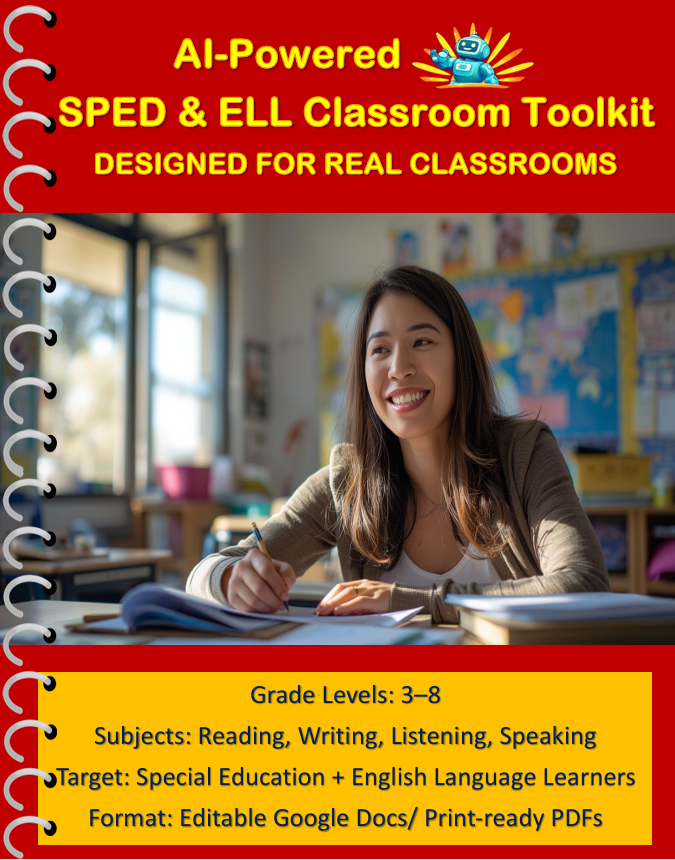
The secret isn’t more work; it’s more integrated work. To keep my own head above water while planning for these diverse needs, I rely on my AI-Powered SPED & ELL Classroom Toolkit. It’s the “Think Tank” that helps me bridge the gap between language levels and disability supports in a fraction of the time.
1. The Collaboration Matrix: Breaking the Silo
The most effective strategy for a dually-identified student happens before they even walk into the room. You and the ESL teacher must be “co-architects.”
Collaboration Tips:
- The Shared Drive: Create a “Living Accommodation Matrix.” This isn’t a static IEP document; it’s a shared sheet where you both list what’s working this week.
- The 15-Minute “Stand-Up”: Once a week, meet for 15 minutes. Focus only on one question: “What language barrier is currently masking their cognitive progress?”
- Role Clarity: In my classroom, I often handle the “Cognitive Scaffolding” (breaking down the task), while the ESL teacher handles the “Linguistic Scaffolding” (providing the sentence frames).
2. Using the PLUSS Framework for Dual Support
If you’ve been following my blog, you know I live by the PLUSS framework. For dually-identified students, it’s not just a suggestion; it’s a lifeline.
| Component | Strategic Application for Dual-Identified Students |
| Pre-teach Vocabulary | Use Cognates. If the student speaks Spanish, use computadora to anchor “computer.” |
| Language Modeling | Use “Think-Alouds” that explicitly name the struggle. “I don’t know this word, so I will look at my picture bank.” |
| Use Visuals | Every slide in your Digital Literacy PowerPoint must have a non-distracting icon. |
| Systematic Instruction | Follow the same Daily Agenda: First Five, Do Now, Whole Group, Practice, Partner, Individual. |
| Strategic Native Language | Allow “Code-Switching.” If they can explain a financial concept in their native language, they know the concept. |
I use the AI-Powered SPED & ELL Classroom Toolkit to quickly generate these “Language Models” for different proficiency levels. It ensures that my Level 1 learners (pre-production) and Level 3 learners (speech emergence) are both challenged.
3. The Accommodation Matrix (Level 1, 2, and 3)
We never “lower the bar”; we just change the “climb.” Here is how I differentiate a single lesson on Workforce Safety in our Digital Literacy block:
- Level 1 (The Sensory Learner): Student uses a “Point and Click” visual board to identify “Danger” vs. “Safe” icons on a digital screen.
- Level 2 (The Transitional Learner): Student uses a sentence starter: “To be safe, I must _________.” with a three-word choice bank.
- Level 3 (The High-Support Independent Learner): Student completes a modified RACE writing frame explaining why a specific digital behavior is unsafe, using speech-to-text tools.
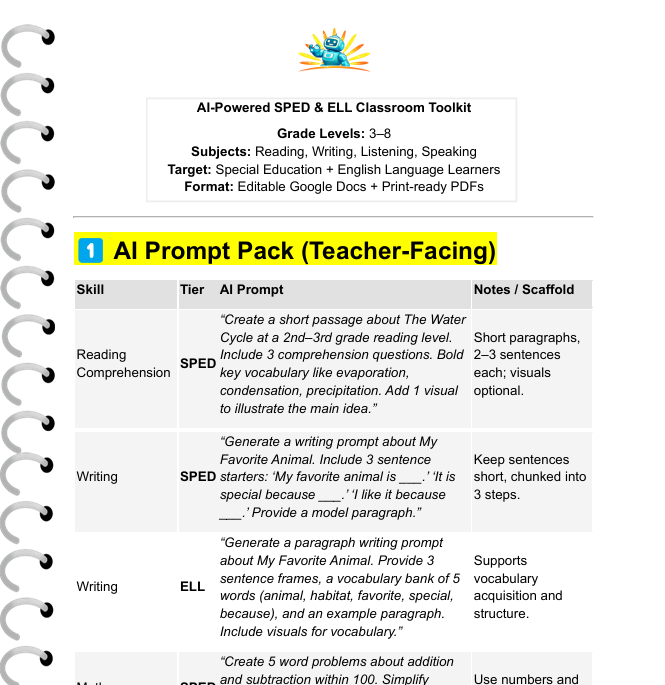
Quickly generates these “Language Models” for different proficiency levels.
4. Digital Tools for the Dual-Identified Classroom
In 2026, technology is the ultimate “Equalizer.” These are the apps that stay open on my browser every single day:
- Immersive Reader: It’s built into most platforms. It provides a picture dictionary and can translate text word-for-word while reading aloud.
- TalkingPoints: Essential for parent collaboration. It translates your texts into the family’s native language and back again.
- MagicSchool AI: Great for taking a complex 50-minute English lesson and “leveling” the text down to a Grade 1 readability while keeping the age-appropriate interest.
- Goblin.tools: My favorite for “Task Analysis.” It breaks a complex direction (like “Log into your Financial Literacy portal”) into tiny, manageable steps.
5. Metacognition and “Productive Struggle”
For students with cognitive disabilities who are also learning a language, “Struggle” can quickly turn into “Shut Down.” As a coach, I want you to teach them to name the struggle.
If a student stops working during the “Partner Work” phase, I don’t give them the answer. I ask: “Is this a ‘Word’ problem (I don’t know what it says) or a ‘How-To’ problem (I don’t know what to do)?” When they can identify the barrier, they are winning. This is why having a consistent toolkit is so vital. When I use the AI-Powered SPED & ELL Classroom Toolkit, the students start to recognize the icons and scaffolds. It becomes their “Digital Home Base,” reducing the cognitive load of navigating new materials.
Conclusion: One Child, One Plan
Dual-identification is a journey, not a label. You are the bridge-builder. By integrating language supports into your special education strategies, you are ensuring that your students aren’t just “present” in the classroom—they are participating.
You are preparing them for a world where they will need to use digital tools, manage their finances, and communicate their needs. Every scaffold you build today is a step toward their independent tomorrow.
Take Back Your Sunday Nights
Stop trying to create three separate lessons. Use the tools that work as hard as you do.
Your Action Plan:
- The Collaboration Check: Ask your ESL teacher for the students’ current “WIDA” or language proficiency levels.
- Grab the Toolkit: Download the AI-Powered SPED & ELL Classroom Toolkit to start automating your differentiation today.
- Join the Newsletter:
Reflection Question: Think of a student who is currently struggling. If you removed the ‘English’ barrier today, what do you think they would be able to show you about their actual cognitive ability?