
This AI tool connects very naturally with the Reflection Coach and Goal-Setting Coach. Here’s the central instructional move:
Task → Demand → Barrier → Strategy → Practice → Check → Adjust
The important part is that students don’t simply receive a list of study tips. They learn why a particular strategy fits a particular learning demand. That makes this a metacognition tool rather than another “study tips” website.
A.C.C.E.S.S. Study Strategy Coach
“Don’t just study harder. Choose a strategy that fits the task.”
Select the primary task category you need to work on:
Different tasks require different kinds of thinking. Select all that apply:
Pinpoint what feels hardest right now so we can match a strategy to fix it:
Here are study strategies grounded in learning science that directly match your task demands:
You selected: –
Try a quick low-stakes practice to build your strategy muscle!
Reflect on how well this strategy helped you manage the task:
📋 MY A.C.C.E.S.S. STUDY STRATEGY PLAN
Strategy Selection Skills Snapshot:
Identify Task Demands:
Pinpoint Learning Barrier:
Match Research Strategy:
Metacognitive Reflection:
Strategy Transfer:
💡 Next Step: Try applying this same strategy in your next assignment!
The instructional architecture I would keep
Our AI tool becomes much more powerful if we treat it as a decision-making coach, rather than a strategy encyclopedia.
For example, a student says:
“I have a science test tomorrow.”
The tool doesn’t immediately say, “Use flashcards.”
Instead:
What are you being asked to do?
→ Remember vocabulary
→ Explain concepts
→ Apply concepts to problems
Then:
What’s difficult?
→ “I recognize the answers when I see them, but I can’t remember them myself.”
Now the coach has enough information:
Recommended strategy: Retrieval Practice.
And then it teaches why:
“You said you can recognize the information but have trouble recalling it. Retrieval practice fits because it makes you practice pulling information from memory instead of simply recognizing it.”
That’s the metacognitive move especially valuable for our A.C.C.E.S.S. system.
And there’s another important feature: “When this strategy may NOT be enough.”
That prevents students from learning another dangerous education myth, that if a strategy doesn’t work, they simply didn’t try hard enough. Sometimes the strategy is wrong for the demand. Sometimes the student needs explicit instruction. Sometimes the barrier is language. Sometimes the student needs an accessibility support. Sometimes they need to ask for help.
That makes the progression:
Choose → Explain → Practice → Check → Adjust → Transfer
rather than:
Choose → Do → Done.
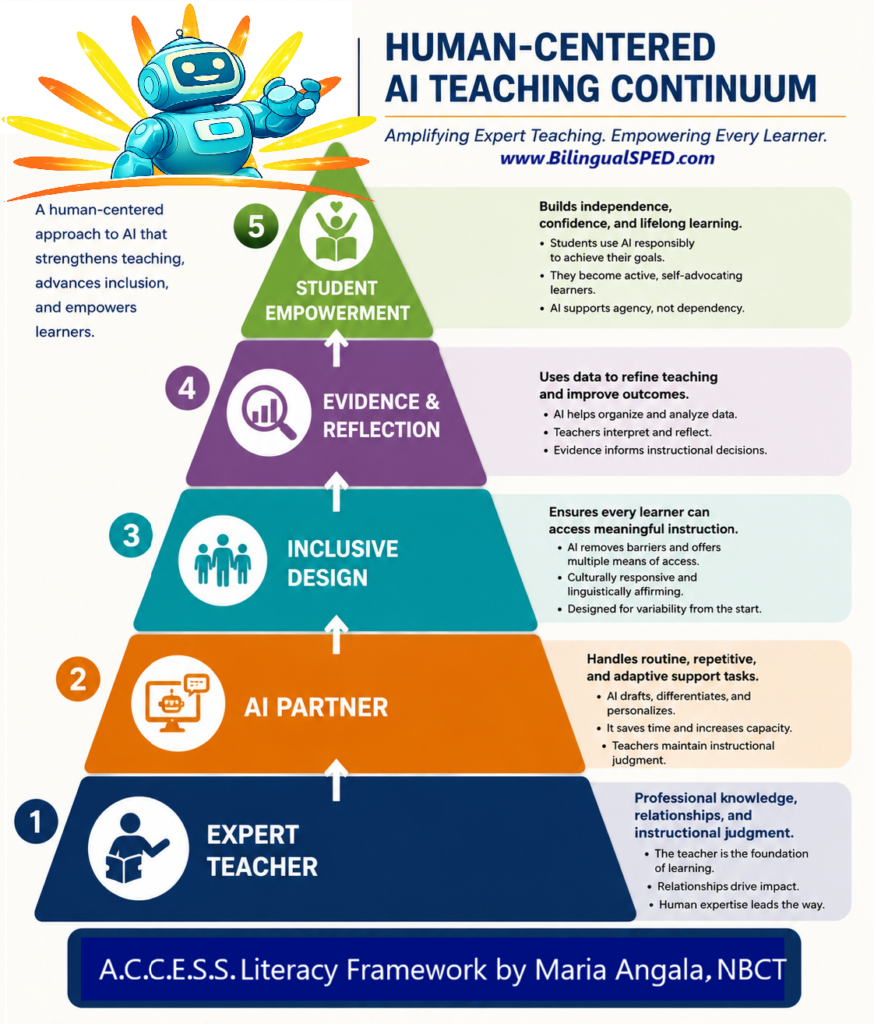
It also gives us a very clean connection among the A.C.C.E.S.S. coaches we’ve been building: the Reflection Coach identifies the barrier, the Study Strategy Coach chooses the response, and the Goal-Setting Coach turns repeated strategy use into measurable independence.
You are the calm in their storm. Keep showing up, keep tracking the data, and keep respecting their dignity. You’ve got this.
.
Join our FUNSHINE Community to receive our latest free A.C.C.E.S.S. AI tools and other updates: