I remember the first time I felt like I was failing a student. It was early in my career, and I was in the middle of a 50-minute Financial Literacy block. A student—let’s call him “J”—had completely shut down. The textbook was on the floor, the chair was pushed back, and the air in the room was thick with that specific kind of tension only special educators truly understand.
My instinct back then was to “correct” the behavior. I wanted compliance. But as I looked at J, I realized he wasn’t trying to be “bad.” He was a Level 2 learner who was being asked to navigate a complex digital banking simulation without the proper scaffolding. His behavior was his only way of saying, “This is too hard, and I don’t feel safe failing in front of you.”
If you are a new teacher standing in that gap today, I want to coach you through a perspective shift. Behavior management in special education isn’t about “control.” It’s about dignity. It’s about building a classroom where the Productive Struggle is supported by such strong structures that the student never feels the need to use their behavior as a weapon or a shield.
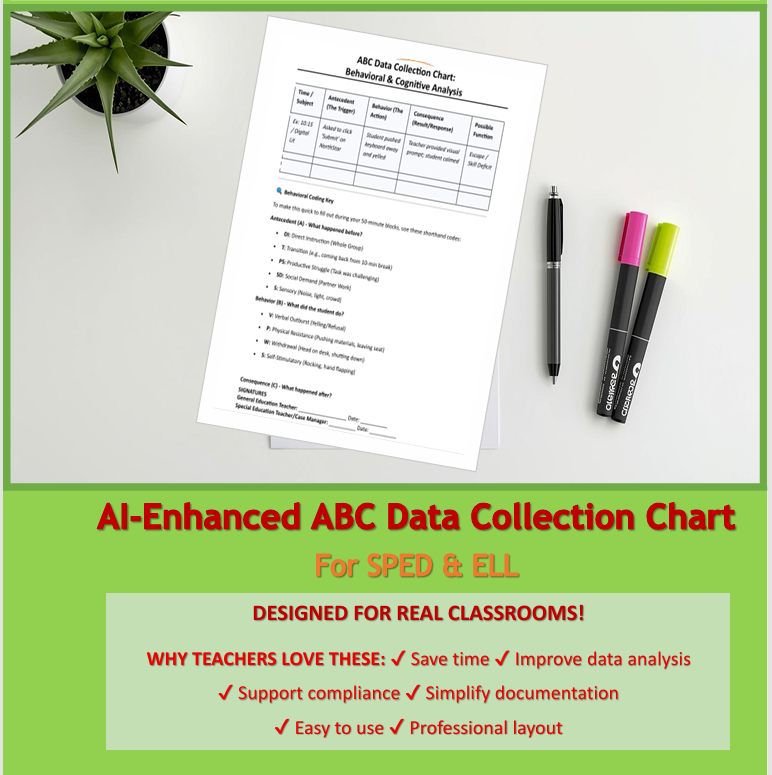
To do this effectively, you need a system that tracks the why behind the what. I’ve spent years refining this, and it’s why I created the Special Ed ABC Behavior Data Chart & IEP Progress Tracker. It’s the tool I use to ensure that when we talk about a student’s behavior, we are talking about data and dignity, not just our own frustrations.
1. The Anatomy of a Dignity-First Classroom
In our 3-hour daily rotation—English, Financial Literacy, and Digital Literacy—predictability is the foundation of behavior management. When a student knows what is coming next, their amygdala stays “offline,” and their prefrontal cortex (the part that handles learning) stays “online.”
The Daily Agenda as a Behavior Tool
We follow the same flow every single day:
- First Five: Transition and check-in.
- Do Now (Warm Up): A low-stakes win to build momentum.
- Whole Group Instruction (I Do): Modeling the metacognitive process.
- Practice (We Do): Supported engagement.
- Partner Work (We Do): Peer-to-peer social learning.
- Individual Work (You Do): The final check for independence.
When you stick to this rhythm, you eliminate the “Fear of the Unknown” which is a massive trigger for students with significant cognitive disabilities and ELL learners.
2. De-escalation: The Art of the “Low-Slow”
When a student’s behavior begins to escalate, your “Teacher Voice” is your most powerful tool—but not in the way you might think. We use the Low-Slow technique.
- Low Volume: The louder they get, the softer you get.
- Slow Pace: Slow down your speech. Give their brain time to process your words.
The Strategy: The “Off-Ramp” Never corner a student. Always provide an “off-ramp” that allows them to save face. Instead of saying, “Pick up that book now,” try, “I can see you’re frustrated with this assignment. You can choose to take a 2-minute sensory break, or we can do the first problem together using the picture icons. I’ll check back in one minute.”
By giving a choice, you return the power to the student. You are maintaining their dignity while still holding the expectation of work. While they take that break, I’m usually grabbing my Special Ed ABC Behavior Data Chart to note the antecedent. Was it the task demand? The noise level? The linguistic load?
3. Visual Supports: The Language of Success
For students with limited English proficiency or cognitive delays, verbal directions can feel like “Charlie Brown’s Teacher”—just a wall of noise. Visuals are the “closed captioning” of the classroom.
Must-Have Visuals for Behavior:
- First/Then Boards: “First 10 minutes of Digital Literacy, Then 2 minutes of music.”
- Wait Cards: A physical object that gives the student a “job” while they wait for your attention.
- The “Stop/Go” Scale: A visual representation of their current emotional state (Green, Yellow, Red).
I use apps like ChoiceWorks to keep these visuals digital and portable. It allows students to manage their own transitions, which is a massive step toward workforce readiness.
4. Data Tracking: Decoding the Message
In special education, we say “Behavior is Communication.” If we aren’t tracking the data, we are missing the message.
New teachers often make the mistake of tracking only the intensity of the behavior. But if you want to change the behavior, you have to track the ABC Pattern:
- A (Antecedent): What happened immediately before?
- B (Behavior): What did the student do? (Be objective: “Hit desk” not “Was mad”).
- C (Consequence): What happened immediately after?
When I use the Special Ed ABC Behavior Data Chart & Progress Tracker, I’m looking for the “Function.” Is the student seeking attention, escaping a task, or seeking a sensory input? Once you know the function, the behavior management plan practically writes itself.
5. Supporting the “Productive Struggle”
In my classroom, we celebrate the struggle. We tell our students, “Your brain is growing because this is hard.” However, we have to differentiate that struggle for our three levels of learners:
- Level 1 (Sensory): Behavior often stems from sensory overwhelm. We provide noise-canceling headphones and tactile breaks.
- Level 2 (Transitional): Behavior often stems from a lack of vocabulary. We provide sentence starters and icon boards.
- Level 3 (Independent): Behavior often stems from a fear of failure. We provide “Errorless Learning” opportunities and metacognitive “Check-Ins.”
Apps like ClassDojo or GoNoodle can be great for reinforcing positive moments, but the real “Behavior Management” happens in the way you design your lesson. If the lesson is accessible, the behavior is manageable.
Conclusion: The Long Game
Behavior management isn’t a “quick fix.” It’s the long game of building trust. It’s showing up every day and proving to your students that you are a “Safe Anchor” in their often-chaotic world.
When you use professional tools like the Special Ed ABC Behavior Data Chart & Progress Tracker, you stop seeing behavior as an “attack” on your teaching and start seeing it as a “puzzle” to be solved. You move from being a “disciplinarian” to being a “detective.”
Ready to Build a Calmer Classroom?
The work you do is hard, but it is holy. You are giving students the emotional regulation skills they need to hold a job, have a family, and be part of their community.
Your Action Plan:
- Audit Your Antecedents: For one week, track what happens right before a behavior. Is there a pattern?
- Simplify Your Data: Grab the Special Ed ABC Behavior Data Chart to make your IEP progress reporting seamless.
- Join the Think Tank:
Reflection Question: When you think of your “most challenging” student, what do you think they are trying to tell you through their behavior that they don’t have the words to say yet?