Why We’re Bringing the A.C.C.E.S.S. Literacy Framework to Myanmar — And Why This Work Is the Most Meaningful Thing I’ve Done

I’m joining the Advisory team for Gift of Education Myanmar to bring the A.C.C.E.S.S. Literacy Framework to Southeast Asia. Standards-based curriculum development starts now. Teacher training launches in May through a structured Professional Development Certification Program. This post is about the literacy gap in Myanmar, why the A.C.C.E.S.S. framework is built for this exact context, and what the Teachers Teaching Teachers model means for sustainable change.

How Linda Darling-Hammond’s Equity Mandate Inspired Me to Build the A.C.C.E.S.S. Literacy Framework for Multilingual Learners and Students With Disabilities

Linda Darling-Hammond’s equity mandate — that professional learning communities must disrupt predictable educational outcomes by race, language, and disability — is the intellectual foundation for the A.C.C.E.S.S. Literacy Framework. This post explores what that mandate means in real classrooms, how each stage of the framework removes specific barriers for multilingual learners and students with disabilities, and why high expectations without strong pathways is just a slogan.

How My Special Education and ELL Students Used This “Evaluating Point of View” Lesson And What Actually Worked

 As a Special Education and English Learner teacher, I used this lesson with students who struggle with reading comprehension and written expression at my Washington DC school. In the specialized world of the Digital Literacy Academy, my classroom serves as a bridge between foundational communication and the practical skills required for the workforce. My students … Read more

How I Tried This “St. Patrick’s Day” Differentiated Writing Lesson With My SPED Students — Here’s the Data and Student Growth

As a Special Education and English Learner teacher, I used this lesson with students who struggle with reading comprehension and written expression at my Washington DC school. In the high-stakes environment of my classroom, my days are spent navigating the intersection of cognitive disability and language acquisition. I am the lead teacher for a group … Read more

How My Special Education & ELL Students Used “Citing Textual Evidence” Lesson — And What Actually Worked

As a Special Education and English Learner teacher, I used this lesson with students who struggle with reading comprehension and written expression, and what I witnessed was a powerful shift in how they engaged with informational text. My name is Maria, and for the past 22 years as a teacher in an inner city school … Read more

How to Teach RI 6.7 Analyzing Text Features AI Enhanced Visual Lesson for SPED & ELL

I often tell new teachers that our students often miss the “signposts” that authors leave behind. These signposts—headings, captions, charts, and bold words—are not just decorations; they are the keys to the kingdom of informational text. In the 6th-grade landscape, specifically under Standard RI.6.7, we focus on integrating information presented in different media or formats. … Read more

How I’m using AI to Enhance my Lesson Planning

Tired of spending hours rewriting the same lesson for students at different levels? In this post, National Board Certified Teacher Maria Angala pulls back the curtain on how she uses AI as an “iteration partner” in her bilingual special education classroom. Teaching students who are navigating both IEPs and English language learning, Maria once spent evenings manually differentiating every text three ways. Now, AI handles the drafts — and she handles the decisions. She shares exactly where AI saves her time (leveling texts, generating sentence frames, simplifying vocabulary) and where it falls short (missing cultural context, overestimating reading levels, using idioms that confuse ELL students). The result? More time for one-on-one instruction, stronger lesson delivery, and a less burned-out teacher. A must-read for any SPED or ELL educator curious about AI — but wanting to stay firmly in the driver’s seat.

How I Tried This Differentiated “Valentine’s Day” Reading Lesson With My SPED Students — Here’s the Data and Student Growth

As a Special Education and English Learner teacher, I used this lesson with students who struggle with reading comprehension and written expression at my Washington DC school. In the world of intensive intervention, the arrival of February often brings a specific kind of anxiety. While the rest of the building is focused on candy and … Read more

How to Use Making Inferences Reading Comprehension Strategy

In a standard classroom, we often tell students to “read between the lines,” but for a neurodiverse learner, those lines can feel like a solid, impenetrable wall. If the information isn’t stated explicitly, it simply doesn’t exist to them yet. As a mentor, I’ve learned that our role isn’t to ask our students to be … Read more

How to Use Main Idea & Details Reading Comprehension Strategy

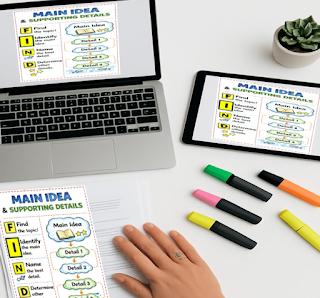
For a neurodiverse learner, the instruction to “find the main idea” is often too vague. It feels like a guessing game where only the teacher knows the right answer. To shift this dynamic, I recently introduced the Main Idea & Supporting Details Strategy Toolkit into our literacy block.

I’ve found that students don’t need more “practice” at being wrong; they need a better framework for being right. By using visual cues and structured task-analysis steps, we take the “guesswork” out of comprehension. We aren’t just giving them a poster to look at; we are giving them a thinking framework that helps them sort “what’s important” from “what’s extra.”