Schools keep buying AI tools before preparing teachers to use them — and it shows. This post looks at why AI adoption in schools keeps stalling, what the data says about the training gap, and why the real work isn’t picking the newest platform. It’s professional learning, clear implementation strategy, ethical guardrails, and letting teachers lead. Written from 22+ years in special education classrooms and professional development, not a vendor pitch.
The Rollout That Taught Me Everything About This

A few years back, I watched a district roll out a brand-new AI platform for IEP goal writing. Big announcement, shiny dashboard, the whole thing. And then — nothing. No training session. No walkthrough. Just a login link in an email and a vague expectation that teachers would “explore it on their own time.”
You can guess what happened. A handful of tech-comfortable teachers poked around and found it useful. Everyone else opened it once, got confused, and went back to their old templates. Six months later, half the staff didn’t even remember the login existed. The tool wasn’t bad. The rollout was.
That’s the story of AI adoption in schools right now, over and over, in district after district. And, it’s kind of maddening, because we already know exactly what went wrong. It’s not a mystery. It’s a training gap, and it’s massive.
So let’s dig into why this keeps happening, what the actual data says about it, and — because I know you didn’t come here just to feel validated in your frustration — what school leaders can do differently, starting Monday.
Why Do So Many AI Rollouts in Schools Fail?
Here’s the blunt version: schools buy tools faster than they build capacity to use them.
A 2025 survey of 6,500 teachers found that 60% were already using AI tools for work — but 76% of them had received zero training on it. Read that again. Three out of four teachers using AI tools with essentially no formal guidance on how to do it well or safely. That’s not a training gap. That’s a training canyon.
And it’s not just one survey catching an outlier moment. A separate 2026 report found that 44% of teachers, principals, and district leaders reported receiving no professional development on AI at all — even as usage kept climbing across the board. Meanwhile, RAND’s research on school districts found a similar pattern: districts project that by the 2025–2026 school year, most low-poverty districts will have trained their teachers on AI use, but only about six in ten high-poverty districts will have managed the same. Which means the training gap isn’t just a gap — it’s an equity issue too.
Quick Win: If your school or district is about to purchase a new AI tool, ask this before signing anything: “What’s the training plan, and is it funded separately from the tool itself?” If there’s no clear answer, that’s your red flag.
What Actually Predicts Successful AI Adoption?
A systematic review of 43 studies on teacher professional development for AI integration landed on a conclusion I find genuinely reassuring, in a “we already knew this” kind of way: technical training alone isn’t enough. Successful integration needs pedagogical knowledge, positive teacher attitudes, real organizational support, and continuous training — not a single one-and-done PD day that gets checked off a compliance list.

In my experience, the schools that get this right share a few things in common, and none of them are about the technology itself:
1. They Lead With Professional Learning, Not Purchase Orders
The most effective rollouts I’ve seen start small — one grade level, one department, one clear use case — with actual hands-on training before wider adoption. Not a 45-minute overview. Real time to try the tool, break it, ask questions, and build confidence with a low-stakes task before it touches student work.
2. They Build Clear Implementation Strategy, Not Vague Encouragement
“Feel free to explore this new tool” is not a strategy. A real implementation plan names who uses it, for what specific task, with what support available when something goes wrong. Schools having genuine success with AI aren’t adopting it indiscriminately — they’re starting with a defined, narrow purpose and building outward from there once teachers are confident.
3. They Set Ethical Guidelines Before Problems Show Up, Not After
This one matters a lot in special education specifically. If an AI tool is drafting IEP language, summarizing behavior data, or generating parent communication, someone needs to have already answered: Who reviews AI-generated content before it goes in a legal document? What data is the tool storing, and where? Are families being told when AI assisted in creating something that affects their child? Teachers report that the lack of clear AI guidance is one of the biggest frustrations right now — not because they don’t want to use these tools, but because nobody told them where the lines are.
4. They Treat Teachers as Leaders, Not Just End Users
Here’s the thing that gets missed constantly: teachers who are given room to lead AI adoption — piloting tools, giving feedback, training their colleagues — end up far more invested than teachers who just get handed a login and a mandate. Distributed leadership isn’t just a nice buzzphrase from a leadership textbook. It’s the actual mechanism that makes adoption stick instead of fading out by spring.
Quick Win: Identify one or two teacher-leaders per building who are already curious about AI, and give them real time (not “on your prep period”) to pilot a tool and train their peers. Word-of-mouth from a trusted colleague beats a district memo every time.
A Lesson That Shows What Good Implementation Actually Looks Like
Classroom context: After that shaky district rollout I mentioned, I ended up being one of the teachers who figured out the AI IEP-writing tool on my own — mostly out of necessity, since my caseload wasn’t shrinking while I waited for someone to train me.
The instructional challenge: I needed IEP present-levels language and goal drafts that actually reflected each student’s needs — sensory accommodations, visual supports available in a family’s home language, social stories for transition routines — not generic boilerplate that could describe any kid in the building.
The lesson approach: I started small and treated it like a real pilot, the way I wished the district had. I fed the tool specific present-level data for one student, reviewed every line it generated, and edited anything that sounded generic or that missed nuance the tool couldn’t possibly know — like the fact that a particular student needed his visual schedule available in two languages and needed the pictures to be photographs, not icons, because abstract images didn’t register for him.
Student response: Not applicable in the traditional sense here — but the real “response” was from the families. Parents told me the present-levels language finally sounded specific to their child instead of copy-pasted, and one mother mentioned she could actually understand the goals in the version translated for her, which she said hadn’t happened with previous IEPs.
Teacher reflection: I’ll be honest, I almost skipped the editing pass the first few times because the draft looked polished. That’s the trap. AI-generated text sounds confident even when it’s wrong or generic, and it takes discipline to slow down and actually check it against what you know about the kid.
What I’d refine next time: I’d build a simple internal checklist before using AI for any IEP document — sensory needs included? Home language addressed? Social story or visual support referenced where relevant? — instead of relying on memory each time. Which, honestly, is exactly what pushed me to build a toolkit around this instead of reinventing my process every caseload cycle.
If your school handed you an AI tool with zero training too, and you don’t want to build your process from scratch the hard way like I did, I put together a complete AI-supported toolkit for exactly this — check out the AI-Supported IEP Writing Toolkit here.
What Ethical AI Adoption Actually Requires
This isn’t optional in special education. When AI touches legal documents, disability data, or communication with families who may already distrust the system, the ethical guardrails aren’t a nice-to-have add-on. Researchers studying school leaders and AI adoption have specifically called for closer attention to power, policy, and equity in these decisions — asking not just “does this tool work” but “who benefits, and who gets left behind, when we adopt it.”
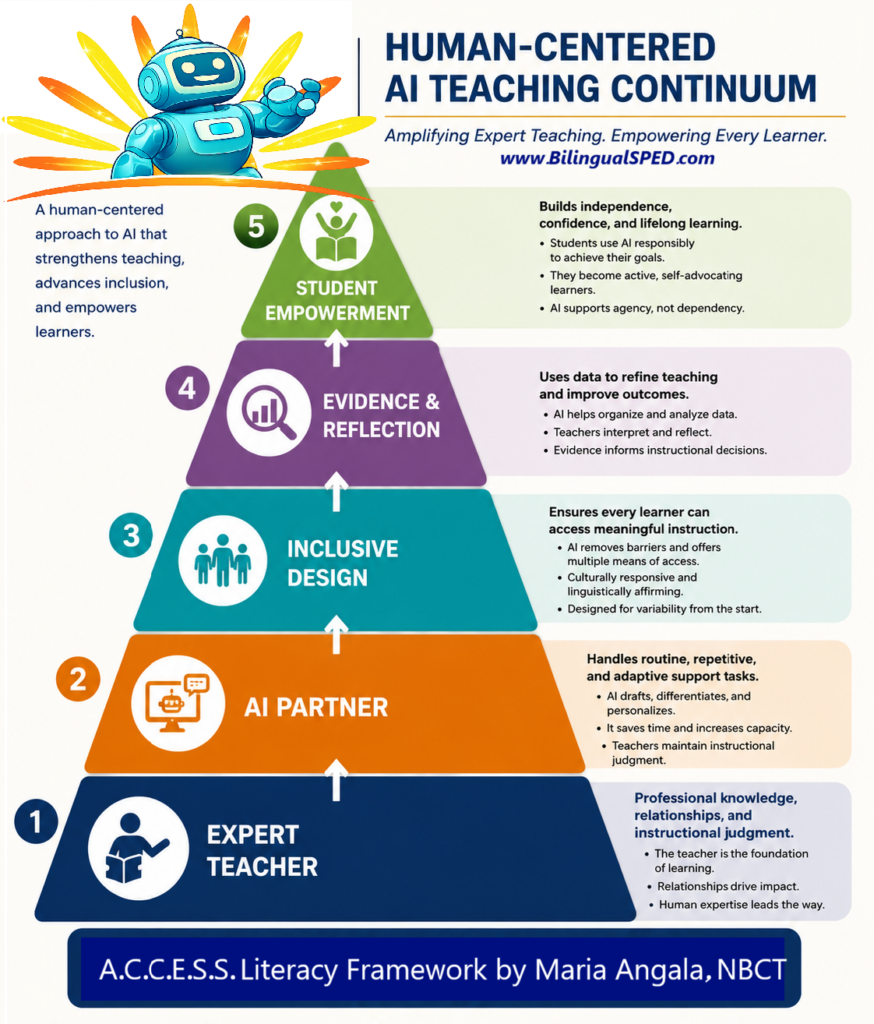
I developed a Human-Centered AI Teaching Continuum embedded within the A.C.C.E.S.S. Literacy Framework to guide educators in using AI ethically and effectively to amplify expert teaching for multilingual learners and students with disabilities.
I’ve noticed the leaders who take this seriously ask uncomfortable questions early: Does this tool work as well for multilingual families as it does for English-speaking ones? Does it require a family to have reliable internet access at home? Is student disability data being stored somewhere a district actually controls? These aren’t gotcha questions. They’re just due diligence, and skipping them is how good intentions turn into real harm.
Quick Win: Before any AI tool touches an IEP, a behavior plan, or family communication, have someone — ideally a special education lead — review it specifically for accessibility, language equity, and data privacy. Don’t assume the vendor already thought of this.
Frequently Asked Questions
Why do so many schools struggle with AI adoption even when teachers want to use it?
The core issue is a training gap, not a motivation gap. Surveys consistently show a majority of teachers are already using AI tools, but the large majority report receiving little or no formal training — leaving them to figure out effective and ethical use largely on their own.
What should school leaders prioritize before purchasing new AI tools?
Professional learning and a clear implementation plan should come before — or alongside — any purchase, not after. That includes defining specific use cases, setting ethical guidelines for sensitive data like IEPs, and identifying teacher-leaders who can pilot and train peers.
How does AI adoption affect special education and multilingual programs specifically?
Special education adds extra ethical weight — AI-generated content often touches legal documents and disability data — and equity gaps in AI adoption tend to widen for high-poverty districts and multilingual families if leaders don’t intentionally address access and language needs from the start.
References
- Third Space Learning, “AI in Education: What’s Really Happening in US Schools in 2026” (2026)
- Education Week, “Teachers Say Lack of AI Guidance Is a Major Problem” (2026)
- RAND Corporation, “More Districts Are Training Teachers on Artificial Intelligence” (2025)
- MDPI Computers, “Artificial Intelligence in K-12 Education: A Systematic Review of Teachers’ Professional Development Needs for AI Integration” (2026)
- Emerald Publishing, “School Leaders and AI-Driven Education: A Comparative Study of Readiness, Perceptions and Implementation Strategies” (2026)
Where to Go From Here
AI adoption in schools isn’t failing because the tools are bad. It’s failing because we keep skipping the boring, unglamorous part — training, planning, and clear ethical guardrails — in favor of the exciting part, which is the shiny new dashboard. Flip that order, and adoption actually sticks.
If you’re navigating AI-supported IEP writing without much district guidance (which, let’s be honest, describes most of us right now), the AI-Supported IEP Writing Toolkit is built for exactly that gap — take a look at it here. It includes the checklist-style approach I mentioned above, built from real trial and error, not a vendor’s best-case demo.
If you want more honest, classroom-and-leadership-tested thinking on AI in special education — no hype, just what actually works — sign up for my email newsletter. I’ll send new strategies and resources straight to your inbox.
Reflection question: Think about the last new tool — AI or otherwise — that got introduced at your school. Did the training come before the rollout, or after everyone was already confused? What would you change about that sequence if you were the one leading it?
You Might Also Like
More strategy and tools like this over at the BilingualSPED.com blog — including posts on the A.C.C.E.S.S. Literacy Framework, IEP writing strategies, and building teacher leadership in special education.