How to Use Making Inferences Reading Comprehension Strategy

In a standard classroom, we often tell students to “read between the lines,” but for a neurodiverse learner, those lines can feel like a solid, impenetrable wall. If the information isn’t stated explicitly, it simply doesn’t exist to them yet. As a mentor, I’ve learned that our role isn’t to ask our students to be … Read more

How to Use Main Idea & Details Reading Comprehension Strategy

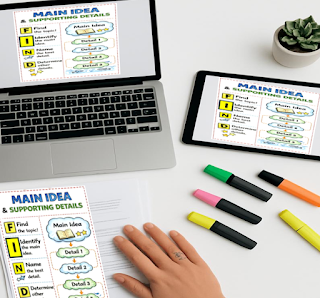
For a neurodiverse learner, the instruction to “find the main idea” is often too vague. It feels like a guessing game where only the teacher knows the right answer. To shift this dynamic, I recently introduced the Main Idea & Supporting Details Strategy Toolkit into our literacy block.

I’ve found that students don’t need more “practice” at being wrong; they need a better framework for being right. By using visual cues and structured task-analysis steps, we take the “guesswork” out of comprehension. We aren’t just giving them a poster to look at; we are giving them a thinking framework that helps them sort “what’s important” from “what’s extra.”

Other Health Impairment (OHI) Under IDEA: What Every Special Education Teacher Needs to Know About ADHD — And Why I Take This One Personally

Other Health Impairment (OHI) is the IDEA disability category that most teachers search for and most families don’t understand — because ADHD lives here, not in its own separate box. This post breaks down what OHI means, how ADHD qualifies under it, and what real classroom support looks like for students who are misunderstood, misidentified, and often just plain exhausted from trying to keep up with a world that wasn’t designed for their brain. It’s also personal. My husband was diagnosed with ADHD in his 50s — and I’d known since college. ADHD isn’t abstract to me. It’s at my dinner table every night.

How to Use RACE/S Strategy Anchor Chart For Writing Center for ELL and SPED

This post explains how to use a RACE strategy anchor chart in a writing center to strengthen students’ constructed responses—especially for English language learners and students with special education needs. It shows how the RACE acronym (Restate, Answer, Connect, End) gives learners a clear, structured path for responding to open-ended questions by teaching them to restate the question, answer it with specific details, connect their response to evidence or broader ideas, and end with a strong conclusion. The anchor chart and printables act as visual scaffolds that make each step tangible and repeatable, helping students build confidence, organization, and text-based writing skills across content areas. Designed for literacy centers, small groups, intervention, SPED, and ELL classrooms, the strategy supports standards-aligned practice and helps students become more strategic and independent writers.
Autism Spectrum Disorder (ASD) Under IDEA: Why a Medical Diagnosis and School Eligibility Are NOT the Same Thing — and What Every Teacher Needs to Understand

Autism Spectrum Disorder is one of the most searched IDEA categories — and one of the most misunderstood. Families arrive at IEP meetings clutching a private diagnosis from a developmental pediatrician, expecting services to begin immediately. And then they hear “we still need to do our own evaluation” and the confusion turns to frustration and sometimes rage. This post is for new teachers who need to understand why that’s true, what the school evaluation actually involves, and how to support autistic students — especially bilingual learners — with real, classroom-tested strategies, sensory accommodations, visual supports, and social stories that work.

Stop the Paperwork Panic: How to Organize Your SPED and ELL Classroom with AI-Ready Forms

This post helps teachers overcome the chaos of classroom paperwork by introducing AI-ready forms and organization systems designed specifically for SPED and ELL settings. It addresses the overwhelm that comes from managing IEP documentation, progress monitoring, behavior records, and communication logs by offering ready-to-use, customizable forms that streamline data collection and reduce cognitive load. With tips on how to integrate these forms into daily routines, organize digital and physical files, and use AI tools to automate repetitive tasks, the post offers practical solutions that save time, improve accuracy, and help educators stay focused on instruction. Educators learn how intentional organization can reduce stress, support compliance, and create a calm, purposeful workflow so they can spend more time with students and less time buried in paperwork.

How to Teach Summarizing as a Reading Comprehension Strategy for Students with Disabilities and ELL Learners

In this post, Maria Angala, NBCT, shares how she teaches students to think about their thinking using a structured metacognition strategy. She explains the shift from focusing only on finished work to helping learners plan, monitor, and reflect on their process, which supports independence and deeper understanding. By breaking tasks into concrete phases—Plan, Monitor, and Reflect—students gain tools to set goals, check their thinking in real time, and evaluate what worked. This approach helps neurodiverse and multilingual learners build executive functioning, self-awareness, and problem-solving skills they can use across content areas and beyond the classroom, preparing them for future success.