
How I Tried This “St. Patrick’s Day” Differentiated Writing Lesson With My SPED Students — Here’s the Data and Student Growth

As a Special Education and English Learner teacher, I used this lesson with students who struggle with reading comprehension and written expression at my Washington DC school. In the high-stakes environment of my classroom, my days are spent navigating the intersection of cognitive disability and language acquisition. I am the lead teacher for a group … Read more

How My Special Education & ELL Students Used “Citing Textual Evidence” Lesson — And What Actually Worked

As a Special Education and English Learner teacher, I used this lesson with students who struggle with reading comprehension and written expression, and what I witnessed was a powerful shift in how they engaged with informational text. My name is Maria, and for the past 22 years as a teacher in an inner city school … Read more

How to Teach RI 6.7 Analyzing Text Features AI Enhanced Visual Lesson for SPED & ELL

I often tell new teachers that our students often miss the “signposts” that authors leave behind. These signposts—headings, captions, charts, and bold words—are not just decorations; they are the keys to the kingdom of informational text. In the 6th-grade landscape, specifically under Standard RI.6.7, we focus on integrating information presented in different media or formats. … Read more

How to Use Making Inferences Reading Comprehension Strategy

In a standard classroom, we often tell students to “read between the lines,” but for a neurodiverse learner, those lines can feel like a solid, impenetrable wall. If the information isn’t stated explicitly, it simply doesn’t exist to them yet. As a mentor, I’ve learned that our role isn’t to ask our students to be … Read more

How to Use Main Idea & Details Reading Comprehension Strategy

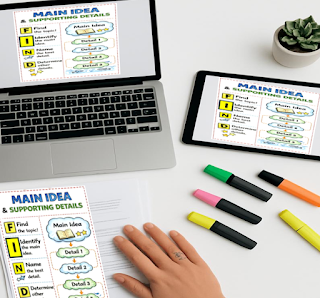
For a neurodiverse learner, the instruction to “find the main idea” is often too vague. It feels like a guessing game where only the teacher knows the right answer. To shift this dynamic, I recently introduced the Main Idea & Supporting Details Strategy Toolkit into our literacy block.

I’ve found that students don’t need more “practice” at being wrong; they need a better framework for being right. By using visual cues and structured task-analysis steps, we take the “guesswork” out of comprehension. We aren’t just giving them a poster to look at; we are giving them a thinking framework that helps them sort “what’s important” from “what’s extra.”

How to Teach Analyzing Characterization & Plot RL 6.3| AI Enhanced Visual Lesson | SPED & ELL

Learn how to teach characterization and plot analysis to SPED and ELL students using an AI-enhanced visual lesson aligned to RL.6.3. This post walks bilingual special education teachers through a structured 60-minute block—Mini-Lesson, Guided Practice, and Independent Work—built around a clear 3-step strategy: Identify the Event, Observe the Reaction, and Determine the Change. Think-aloud modeling, high-contrast visual organizers, and sentence frames help neurodiverse and Tier 3 learners move beyond “what happened” to understanding how plot episodes shape a character’s growth. Includes extension activities connecting to RL.6.5, a Quick Quiz for IEP data collection, and an accommodations checklist—giving every student the tools to see themselves in the stories they read.

How to Use Sequence of Events Reading Comprehension Strategy

Discover how to teach sequence of events as a visual, repeatable strategy for SPED and ELL students who struggle to organize narrative information. This post shows bilingual special education teachers how moving beyond “beginning, middle, end” to a four-step framework—Identify Key Events, Order the Facts, Use Transition Words, and Retell with Accuracy—transforms passive readers into active, organized thinkers. Real classroom moments reveal students independently using anchor charts and transition word banks to debate event order and retell stories without teacher prompts. Framed as a foundational workforce skill, sequencing prepares students for multi-step job tasks while strengthening both reading comprehension and written retelling across fiction and nonfiction texts.

How I Tried This Differentiated “RACE Writing Strategy” Lesson With My SPED Students — Here’s the Data and Student Growth

A DC bilingual SPED teacher shares real data and classroom breakthroughs from using a differentiated RACE Writing Strategy lesson built around MLK quotes with ELL students with cognitive disabilities. This post details how tiered graphic organizers—with heavy sentence starters for Level 1 and more independent drafting for Levels 2 and 3—transformed blank-page shutdown into productive struggle. Two powerful student moments illustrate the shift, and the numbers back it up: successful evidence citations jumped from 20% to 65% independence in one week, a 45% growth in structural accuracy. Learn how treating writing as an engineering task, not a creative one, gives SPED students the repeatable blueprint they need to find their voice.

What Happens When You Teach “Main Idea” to Struggling Readers the Right Way

A DC bilingual SPED teacher shares real classroom results from teaching main idea the right way—by making the thinking process visible, not just the text shorter. This post details how umbrella-and-pillars metaphors, color-coded text, and scaffolded graphic organizers helped Level 1 and Level 2 ELL students with cognitive disabilities move from guessing to evidence-based logic. Two powerful classroom moments—a nonverbal student independently identifying patterns and a peer spontaneously using metaphor to explain linguistic hierarchy—show what’s possible. Accuracy on main idea prompts jumped from 30% to 75% within one unit, proving that the right scaffolds respect student intelligence while supporting their processing needs.

Classroom-Tested TpT Resource: Reading Comprehension Bundle

A veteran bilingual SPED teacher shares an honest, classroom-tested deep dive into the RACE Writing Strategy MegaBUNDLE for constructed response—designed for special education and ELL students. This post walks through a real 6-week implementation plan, week by week, covering how to build from Restate all the way to Explain using multi-level passages, sentence frames, color-coding, graphic organizers, and sensory accommodations. Learn how high-interest holiday and quote-based texts keep engagement high while reducing writing anxiety. Includes troubleshooting tips for reluctant writers, strategies for significantly modified learners, and results data showing students transfer RACE across content areas—building a life skill, not just a test strategy.