Sunday Night. Again.
It’s 8:47 p.m. on a Sunday and I’m still at my kitchen table. Not because I’m behind—I’m actually ahead by most standards. The unit plan is done. The anchor chart is printed. The read-aloud text is selected and aligned to the standard. I know exactly what I want students to do tomorrow.
But I have eleven students. And no two of them are in the same place academically.
Three students are working significantly below grade level—two of them have IEPs targeting foundational literacy, one is a non-verbal communicator who uses an AAC device. Four students are English learners at varying WIDA proficiency levels, two of whom also carry special education designations, which means they’re operating under two legal frameworks at once. The rest of the class spans two or three years of reading range even within what would technically be called “grade level.”

This is not a hypothetical classroom. This is just Tuesday in a bilingual self-contained SPED setting.
So I sit there, and I rewrite. Same lesson, same standard—CCSS.ELA-Literacy.RI.6.4, determining the meaning of words and phrases in an informational text. But I rewrite the text three times. I rewrite the sentence frames four times. I rewrite the question stems to match different language proficiency levels. By the time I’m done, I’ve produced what is essentially six different lesson versions for eleven kids.
This is differentiation overload. And it’s the normal that nobody outside special education fully understands.
What Changed—And What Didn’t
I want to be direct here: AI didn’t solve my differentiation problem. It solved a specific planning problem I already had.
The problem wasn’t that I didn’t know how to differentiate. I’ve been doing this for over two decades. I know my students’ IEP goals by memory. I know which vocabulary words will derail a lesson before I even begin. I know which student needs a visual anchor and which one needs the first sentence read aloud before they can independently engage.
The problem was time. Specifically: the gap between knowing what my students needed and having the physical hours to produce it before 7:30 a.m. Monday.
AI—used deliberately, as a drafting tool—started closing that gap.
| Here’s what that looks like in practice: I build one lesson. I define the skill and the standard. I identify my three learner groups. I give AI a specific, bounded prompt that describes the reading level, the scaffolding goal, and any language or cultural considerations I want it to account for. It produces a draft. I revise. Every. Single. Time. But I’m revising from something instead of building from nothing—and that’s the difference between Sunday at 11 p.m. and Sunday at 7 p.m. |
Walk Through One Lesson With Me
Let’s use a real lesson structure—no student names, no identifying data, strictly generalized to protect everyone involved. The skill: identifying text structure in an informational passage about community helpers. The standard: RI.5.5 (adapted). The class: a mixed group of students with disabilities and English learners, grades 4–6, functioning across a wide range of independent reading levels.
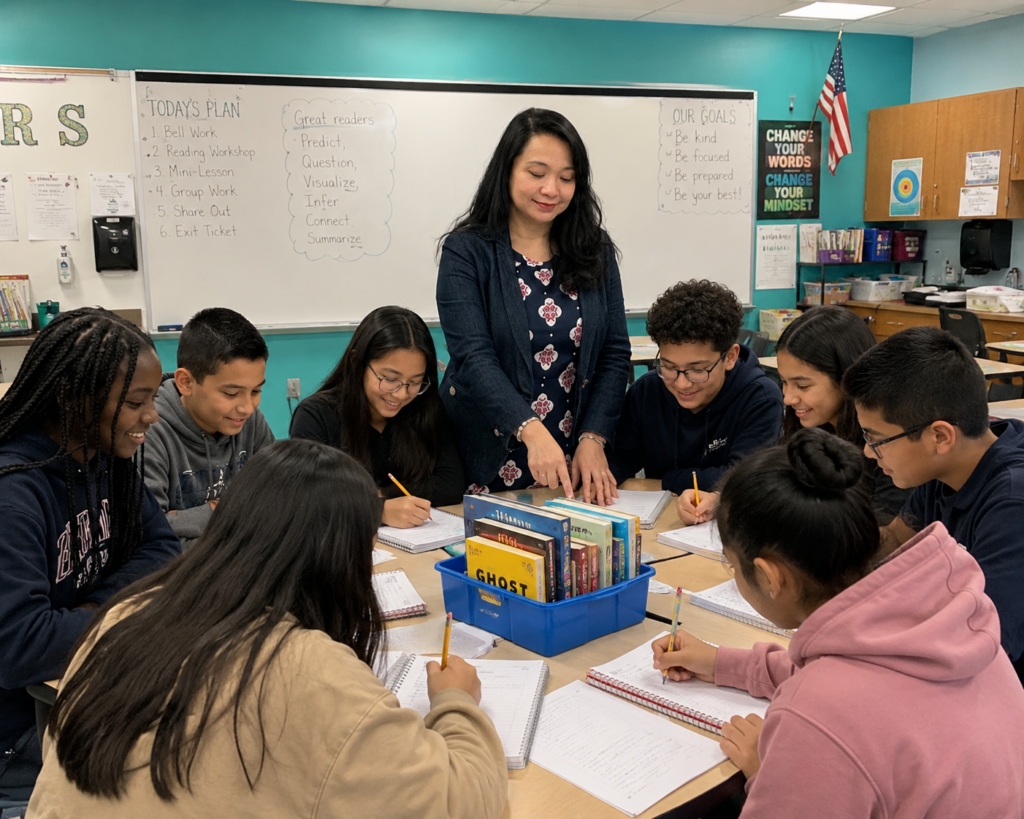
Step 1: I decide the standard. AI doesn’t touch this.
The instructional goal is mine. The standard is mine. I know what mastery looks like for each student based on their IEP baselines, their progress monitoring data, and my own observational notes. AI has no access to that information—and I don’t give it any. No names, no IEP details, no district data. I’m working with a generalized student profile when I prompt.
Step 2: I build the core lesson first.
On-grade-level version goes in first. I write this myself. The text is selected, the questions are drafted, the objective is clear. This is my anchor version—everything else scaffolds down or extends from here.
Step 3: I ask AI to produce two additional versions.
My prompt is specific. I don’t say “simplify this.” I say something like: “Rewrite this passage at a 2nd-grade reading level for a student who is an English learner at WIDA Level 2, is working on identifying main idea in short texts, and benefits from short sentences, concrete vocabulary, and bolded key terms. Do not use idioms.”
That specificity matters enormously. Vague prompts produce vague output—which then requires extensive revision. Precise prompts reduce that revision load significantly.
For the enrichment version, my prompt shifts: “Extend this passage with a paragraph that introduces compare/contrast text structure. Include two complex sentences and an inferential question that asks the student to evaluate author’s word choice.”
Step 4: I revise all three versions manually.
This step is non-negotiable—and it’s where AI consistently proves it’s a drafting tool, not a finished product.
Here’s what I find almost every time: AI overestimates reading level on the “below grade” version. It thinks it simplified the text, but it kept phrases like “occupational role” or “municipal services”—words my students have genuinely never encountered. I replace those.
It also misses cultural context, regularly. In one version it used a grocery store scenario and referenced deli counters—which meant nothing to students whose home food culture doesn’t include that. I swapped it for something familiar. That’s not something AI can know without me telling it, and I’m not going to feed it details about my students’ home lives to find out.
And sometimes AI produces language that’s technically at the right Lexile level but feels stiff, over-formal, weirdly corporate in tone. Real kids—especially kids with language-based learning differences—need writing that sounds like a person wrote it. I fix the register.
But here’s the thing: fixing all of that takes about 20 minutes. Building from scratch used to take 2 hours. That math is why this works.
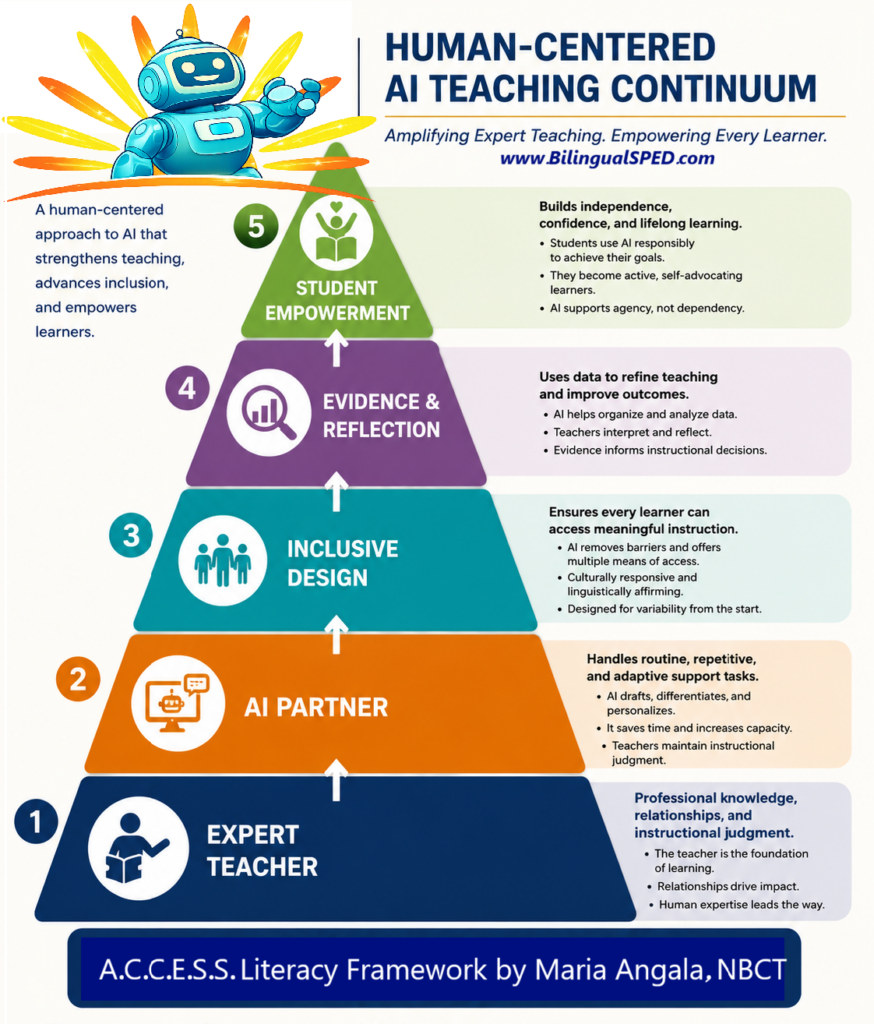
I developed a Human-Centered AI Teaching Continuum embedded within the A.C.C.E.S.S. Literacy Framework to guide educators in using AI ethically and effectively to amplify expert teaching for multilingual learners and students with disabilities.
| 🛒 CLASSROOM TOOLKIT | If you want the ready-made version of what I described here, I created a complete classroom toolkit with pre-built differentiated lesson templates, sentence frame banks, and AI prompt guides organized by standard and learner profile. Grab it on TpT here → teacherspayteachers.com/store/maria-angala-nbct |
What AI Can’t Do—And Why That’s the Whole Point
I’ve had colleagues ask me if using AI this way is “really” differentiation or just outsourcing the work. I understand the question. But I think it misunderstands what the work actually is.
The work of differentiation isn’t producing three different PDFs. The work is knowing your students well enough to determine what each one needs, building a learning pathway that meets them where they are without lowering the ceiling, and making instructional decisions in real time when the lesson goes sideways—which it always does.
AI does not do any of that. AI doesn’t know that one student shuts down when text is too long on the page, not too hard—just visually overwhelming. AI doesn’t know that another student can decode fluently but misses inferential meaning at every turn, so enrichment passages need to explicitly scaffold analysis, not just add more text. AI doesn’t know which student had a hard morning before school and needs the first three minutes of class to be low-stakes.
I know those things. AI is just my iteration partner for producing the materials my decisions require.
The Three Outputs That Used to Take a Sunday Afternoon
Here’s what I’m producing—consistently, with AI’s drafting support—in roughly 20–25 minutes total prep time per lesson:
- Version 1 — Below Grade / Supported Access: Leveled text at 1–2 years below grade. Sentence frames embedded directly into the worksheet. Pre-taught vocabulary with visuals. Simplified question stems that target the same standard. For my dual-identified EL/SPED students, this version also includes a first-language vocabulary reference and a visual sentence starter strip.
- Version 2 — On Grade Level: The anchor version. Grade-appropriate text complexity. Scaffolded questions with text evidence prompts. Academic vocabulary highlighted but not pre-defined—students use context clues as part of the skill practice.
- Version 3 — Enrichment / Extension: Extended text with increased complexity. Inferential and evaluative question stems. A stretch writing prompt that asks students to apply the skill in a new context. For students whose IEP goals include written expression, this version integrates that goal naturally.
Same standard. Same instructional outcome. Three entry points. Every student accesses the skill—just through a door that fits them.
Why This Matters Especially in EL/SPED Classrooms
The range of needs in a bilingual special education classroom isn’t just wide—it’s multi-dimensional. A student with an intellectual disability who is also an English learner at WIDA Level 1 isn’t simply “two levels below.” They’re navigating academic language acquisition and a disability-related learning profile simultaneously. The scaffolding requirements interact in ways that generic differentiation tools don’t account for.
When I use AI as a planning support for these students, I’m adding layers that I have to specify carefully. I’m not just saying “simplify.” I’m saying: shorter sentences, concrete vocabulary, familiar cultural references, no idiomatic language, visual cue compatibility, first-language cognate awareness if the student is Spanish-speaking.
AI can execute a prompt like that reasonably well. But I’m the one who knows it’s needed. Standards and students are always the drivers.
The Workflow, Compressed
For teachers who want to try this, here’s the actual sequence I use:
- Identify the standard and the specific skill students are practicing.
- Build your on-grade version first. AI works from your anchor.
- Write precise prompts. Include reading level, proficiency level, scaffold type, cultural notes, and what to avoid.
- Generate all three versions. AI produces drafts in under two minutes combined.
- Revise manually. Check language level, cultural fit, vocabulary load, visual layout, and alignment to each student’s IEP goals or language development targets.
- Approve before copying. Nothing goes to students until I’ve read every word.
That’s it. That’s the whole system. And yes—the revision step takes real time and real expertise. But it’s the kind of time that builds my craft instead of depleting it.
References & Further Reading
These are the sources and research I draw on when thinking about AI’s role in differentiated instruction:
1. How AI Tools Can Support Special Education Students and Teachers — EdTech Magazine (2026)
2. Artificial Intelligence Integration in TESOL Teacher Education — TESOL Quarterly / Wiley (2025)
3. Short on resources, special educators are using AI — The Conversation (2026)
Frequently Asked Questions
Q1: Is using AI for lesson differentiation considered academic dishonesty or a shortcut?
No—and I think this framing misunderstands what differentiation actually requires. Using AI as a drafting tool is comparable to using a word processor to write. The thinking, the decision-making, and the pedagogical judgment are entirely mine. AI generates a draft; I revise it against my knowledge of the standard, the student profiles, and the IEP goals. Nothing goes to students until I’ve reviewed and approved every version. The professional work is still happening—it’s just happening faster.
Q2: What if AI produces a differentiated version that isn’t actually appropriate for my students?
It will. That’s expected. AI consistently overestimates “simplified” reading levels, misses cultural context, and occasionally uses vocabulary that’s technically at the right Lexile but wrong for the student’s actual experience. This is why the manual revision step is non-negotiable in my workflow. I treat every AI output as a rough draft that requires expert editing—because that’s exactly what it is. The revision process is where your professional knowledge does the work AI can’t.
Q3: How do I use AI for differentiation without entering any private student data?
You work with generalized profiles, never individual student data. Instead of entering a student’s name or IEP details, you describe a learner type: “a student at WIDA Level 2 who benefits from short sentences, concrete vocabulary, and visual supports.” That’s enough for AI to produce a useful draft—and it keeps all private, legally protected information exactly where it belongs: in your IEP files, not in a public-facing AI tool. No names, no identifying information, no exceptions.
The Last Thing I Want You to Take From This
I’ve been a bilingual special education teacher for over two decades. I’ve seen a lot of “this will change everything” tools come through professional development sessions and disappear quietly by spring.
AI is different—not because it’s magic, but because it solves a specific, real, grinding problem that experienced teachers know exactly. The problem isn’t knowing how to differentiate. The problem is having enough hours in the day to produce what our students actually need.
When I use AI as an iteration partner in my planning, I don’t stop being the teacher. I stop being the typist. I get to spend the cognitive energy that used to go into rewriting the same passage six ways on the things that matter more—observing my students, adjusting in real time, building the kind of relationships that make students willing to try hard things.
AI helps me teach better. It doesn’t decide how I teach.
The standard is mine. The students are mine. The instructional goal is mine. AI is just the tool that helps me get there without burning out by October.
You Might Also Like
📖 Designing Lessons for Real Kids, Not Pinterest: What Actually Works in My SPED Classroom
📖 How I Teach Vocabulary to ELL Students with Structured Supports
📖 From “Cheating” to “Solving”: The New AI Mindset
📖 Is AI Really the “Next Frontier” or Just Another Buzzword?
📖 Why the A.C.C.E.S.S. Literacy Framework Is Built Like a Bridge—And Why That’s the Whole Point
| 📬 Want more like this in your inbox? Join thousands of SPED and ELL educators who get practical, classroom-tested strategies delivered straight to their inbox—no fluff, no buzzwords. Just the real stuff that works with real kids. → Sign up at: www.bilingualsped.com |
Before You Go — A Reflection Question
| 💬 For You: Think about the last time differentiation planning cost you hours on a Sunday. What was the standard? What were the student profiles in the room? If you had handed AI a precise prompt that evening, what’s the one revision you know you would have had to make—because only you know your students well enough to catch it? Drop your answer in the comments below. I read every single one. And if you’re comfortable sharing the revision—that’s where the real conversation starts. |