I met with Thu Ta, founder of Connected Oregon Padauk Education (COPE), to talk about bringing the A.C.C.E.S.S. Literacy Framework™ to teachers serving displaced and multilingual students in Thailand and Myanmar. We agreed on a hybrid virtual training partnership starting this September — our eighth country. This post breaks down the literacy crisis behind that decision, the framework itself, and what I’m learning about building something global instead of staying local.
Who Is Thu Ta, and Why Did I End Up on a Call With Him at 6 A.M. His Time?
Here’s the thing about international collaboration — it almost never starts the way you’d plan it. Ours started on LinkedIn, (the same way I met another educator I deeply admire), and it almost fell apart in the first two minutes because neither of us could hear the other over a Bluetooth glitch.
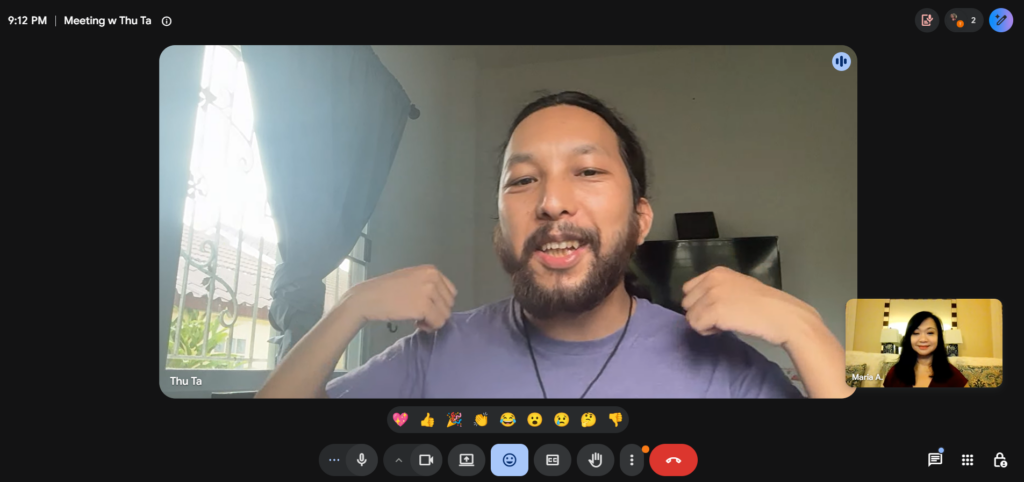
Thu Ta grew up in Shan State, Myanmar, in a mountain region with limited education access. He earned an undergraduate degree and a first master’s in English literature, then — in the middle of COVID, in 2020 — received a U.S. scholarship to study educational leadership at the University of Oregon. He was mid-program when the 2021 military takeover happened back home. He stayed in Oregon, worked as an assistant special education teacher (rough first weeks, by his own account), and eventually relocated to Thailand, close enough to the border that he can see Myanmar’s mountains from where he lives now.
In late 2025, with basically zero dollars in a bank account, he registered a nonprofit: Connected Oregon Padauk Education, or COPE. Padauk is Myanmar’s national flower — it blooms once a year, right around the Myanmar new year. He named a nonprofit after a flower that only blooms once a year for a reason, and honestly? That detail stuck with me more than almost anything else he said.
COPE runs an Educational Leadership Fellowship — two cohorts so far, recruiting education leaders and administrators from across different political control zones in Myanmar, because as Thu Ta put it, the point is the students, not the politics. COPE has also hosted more than a dozen free community webinars open to the public, working with university partners and diaspora scholars from several countries. Everything COPE does right now is free. No charge to participants. Which, if I’m honest, is exactly the same stubborn, financially-unsustainable-but-morally-nonnegotiable decision I made with my own training work. We didn’t plan to both start this work running on fumes, to be doing the same thing in the same way. We just were.
Quick Win: If you're building any kind of cross-border education partnership, don't skip the "who are you and why does this matter to you" conversation to get to logistics faster. The logistics come easy once two people trust each other's why. We spent the first twenty minutes just telling our stories, and that turned out to be the most important twenty minutes of the whole call.
What’s the Actual Literacy Crisis Behind This Conversation?
I want to be clear about something: this isn’t a nice-story blog post about two educators who happened to click. There’s a hard, data-backed reason this partnership matters, and if you’re a teacher reading this in a 45-student classroom right now, you already feel it.
Globally, 53% of children in low- and middle-income countries can’t read and understand age-appropriate text by age ten — a benchmark the World Bank and UNESCO call “learning poverty” (World Bank–UNESCO Learning Poverty Global Database). That’s not a small-country problem. That’s a “more than half the kids in the room” problem.
And here’s the piece that connects directly to what Thu Ta and I both do: roughly 40% of learners worldwide aren’t being taught in a language they actually speak and understand — and in some low- and middle-income countries, that number climbs as high as 90% (UNESCO Global Education Monitoring Report, Languages Matter, 2025). Think about that for a second. Nine out of ten kids, in some places, sitting through instruction in a language they’re still learning to speak. No wonder the literacy scores are low. It’s not that the teachers aren’t working hard — they absolutely are. It’s that nobody gave them a system built for that reality.
Layer conflict on top of that and it gets worse fast. In Myanmar specifically, an estimated 3.4 million children currently need urgent learning support because of ongoing conflict, displacement, and disrupted schooling (UNICEF Myanmar Humanitarian Appeal, 2026). Some of Thu Ta’s own fellowship participants have had to drop out mid-program — not because they weren’t committed, but because of unreliable electricity, spotty internet, or active conflict zones near where they live. He told me, plainly, that roughly two-thirds of each cohort makes it to graduation. That’s not a failure rate. Given everything working against them, that’s a quiet act of stubbornness I have enormous respect for.
So when I say “we’re not begging for access, we’re bringing A.C.C.E.S.S. to the world” — I mean it literally. This framework was never designed as charity. It was designed as infrastructure, for exactly the classrooms the data above describes. (I go deeper into why a framework has to be built for adaptation from day one — not retrofitted later — in this piece on building an international community of practice around A.C.C.E.S.S., if the “why” behind all this is interesting to you.)
How Does the A.C.C.E.S.S. Literacy Framework Actually Solve This?
I’ve been coaching new teachers for a long time now, and I always tell them the same thing when they’re drowning in a 40-to-60-student classroom with five different home languages in the room: you don’t need more strategies. You need a system. Random strategies pulled from Pinterest don’t scale. A repeatable daily structure does.
That’s what A.C.C.E.S.S. is — Activate, Clarify, Chunk, Engage, Support, Synthesize. Six steps, same order, every single lesson, regardless of subject or grade level:
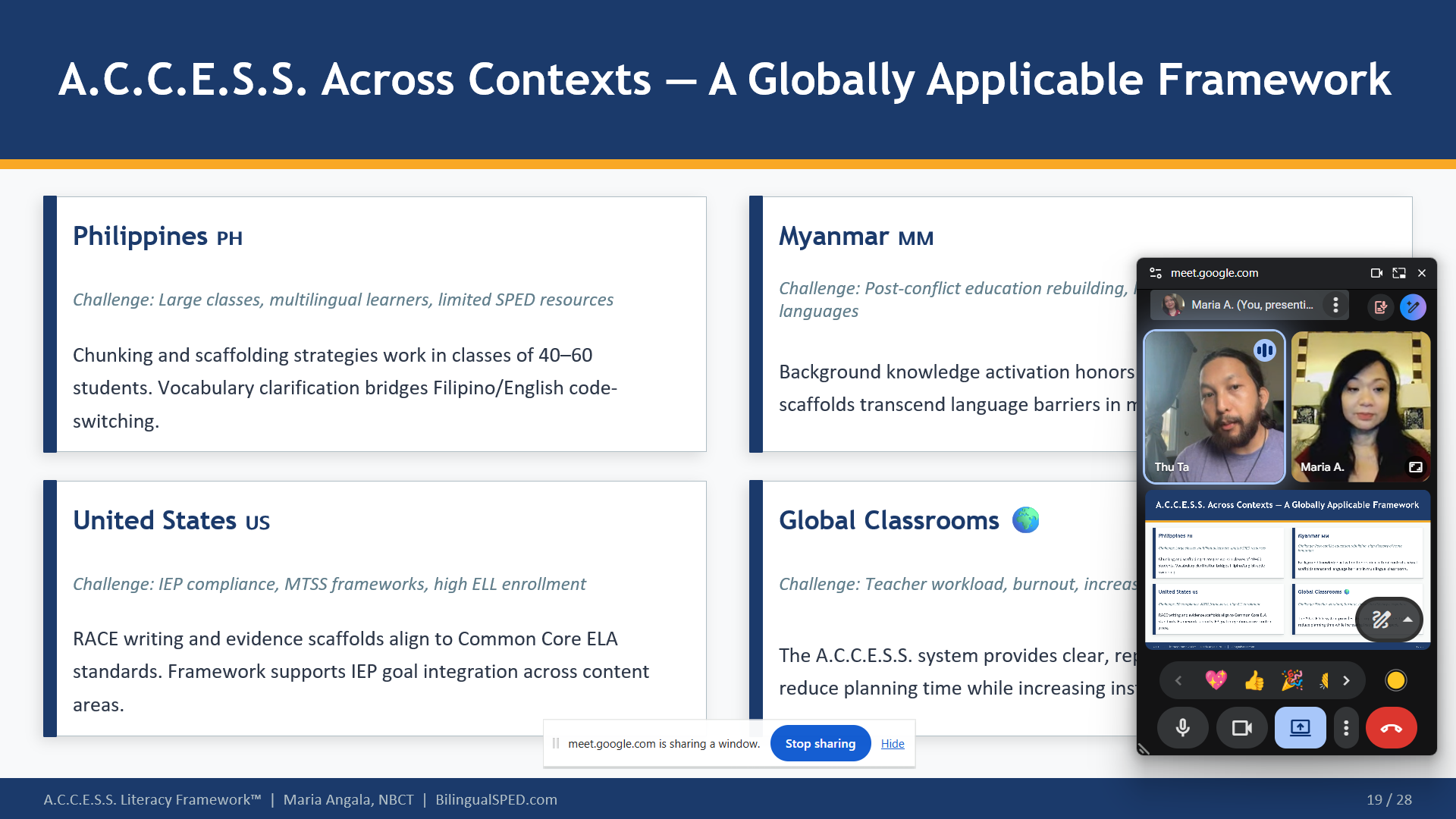
- Activate — connect new learning to what students already know, in whatever language or dialect that knowledge lives in.
- Clarify — pre-teach academic vocabulary before the text, not during it. This alone fixes half the “my students can’t access grade-level content” complaints I hear.
- Chunk — break dense text into manageable pieces instead of handing over a full passage and hoping for the best.
- Engage — writing, discussion, Socratic questioning — students working with the text, not guessing at it.
- Support — scaffolds that come out gradually, not permanently. Sensory accommodations for neurodivergent learners. Visual supports built in multiple languages, not just translated afterthoughts. Social stories where a student genuinely needs the “why” behind a classroom routine spelled out instead of assumed.
- Synthesize — students show what they learned, without lowering the rigor to get there.
Quick Win: If you only implement one piece of this today, make it Clarify. Pre-teach five to eight vocabulary words before you hand over any text, not during. It's the single highest-leverage change I've watched teachers make, and it costs you maybe five extra minutes.
I also folded in a Human-Centered AI Teaching (HCAIT) Continuum, because — look, AI training for teachers is becoming mandatory in a lot of U.S. districts right now, and I got genuinely worried that teachers in the hardest-hit parts of the world would get left even further behind. So the certification pathway (three levels — Certified Practitioner, Certified Instructor, Certified Trainer) folds AI literacy in alongside the six framework components, delivered virtually with asynchronous backup materials for teachers who lose connectivity mid-session. Because they will. That’s not a hypothetical for the communities Thu Ta serves — that’s Tuesday.
If you want the full breakdown of how this scales across completely different linguistic and cultural contexts — not just Thailand and Myanmar, but the Philippines, Malaysia, India, and soon Afghanistan — I actually wrote a much deeper piece on that exact question. Read “Building an International Community of Practice Around the A.C.C.E.S.S. Literacy Framework™” if you want the mechanics of framework adaptation across borders — it pairs well with everything I’m describing here.
What Actually Happened When We Talked?
Once the audio finally worked, the conversation moved fast. I gave Thu Ta the same overview I give every new partner — my background in bilingual special education, why I started training teachers globally, and what makes A.C.C.E.S.S. different from a strategy binder. He asked sharp, specific questions: How long does Level 1 certification take? Is it synchronous? What’s the ideal cohort size?
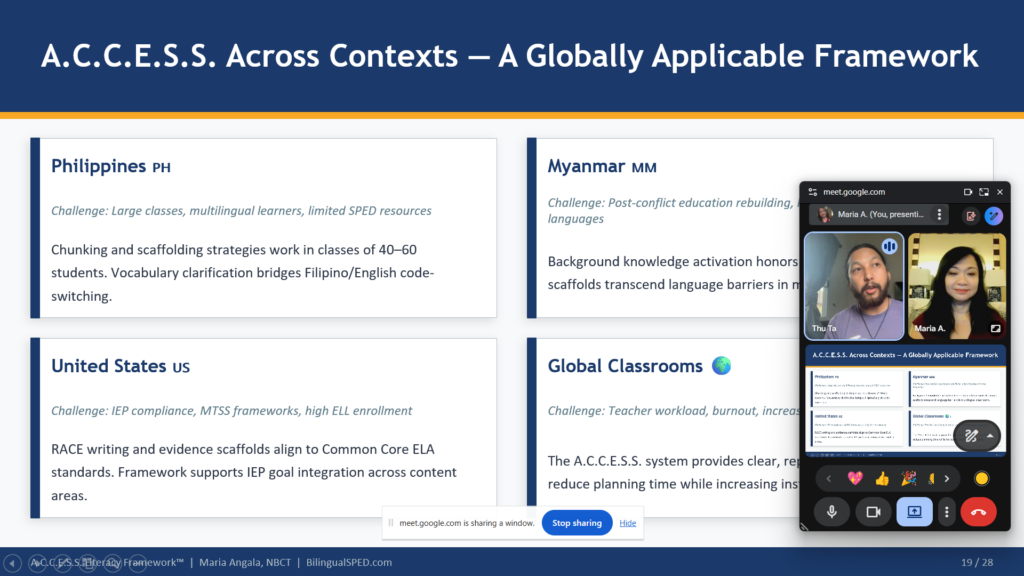
That last question mattered more than it sounds. Thu Ta told me he used to chase enrollment numbers — more people, more reach, more impact, or so it seemed. A few months in, he learned it’s not about the numbers. It’s about the quality of what those ten or fifteen educators can actually carry back into their communities. We landed on the same conclusion independently, which is honestly a little wild — I’ve run sessions of 120 in Malaysia and sessions of 15 in Myanmar, and the smaller ones aren’t lesser. They’re just measured differently. Ten committed teachers, each reaching 40 to 60 students, is not a small number. Do the math on that. It adds up fast.
And then the conversation turned personal, the way these things do when two people recognize the same loneliness in each other. Thu Ta told me he’d felt isolated doing this work — watching well-meaning scholars and practitioners from wealthier countries talk about his region without ever really understanding what’s happening on the ground in it. I told him I know that feeling exactly, because I’ve sat through plenty of “expert” trainings myself and thought: do you actually understand what walking into my classroom feels like? We talked about how war and borders divide people, but literacy — real, structured, dignity-respecting literacy instruction — connects them anyway. That’s not a slogan. That’s just what the last hour of that call felt like.
We agreed to bring A.C.C.E.S.S. training to his network starting this September, alongside my existing Myanmar cohort. Same hybrid model — live virtual sessions plus asynchronous materials on Teachable for teachers who miss a session or lose connectivity. That makes this my eighth country — and yes, it’s a completely different context from where the framework started, which is exactly the kind of stretch-test I wrote about here when I first realized one classroom, or one country, was never going to be enough.
What Am I Taking Away From This?
Honestly? Relief, mostly. And a little bit of “why did it take this long to find him.”
I’ve said this before (to another educator doing similar work), and I’ll say it here again: when you’re building something this specific — literacy access for multilingual, neurodivergent, under-resourced learners, at a global scale, without a corporate budget behind you — it can feel like you’re the only person doing it. You’re not. You’re just not connected yet. Thu Ta found me. I’d found someone else before him. That’s not a coincidence pattern. That’s what happens when you keep showing up publicly and doing the work loudly enough that other people doing the same work can find you.
What Would I Refine Next Time?
A few things, if I’m being honest with myself the way I’d want a new teacher to be honest in a reflection log:
I’d build the outcome-data structure into the very first session, not retrofit it later. If we’re documenting this partnership’s impact — and we should be — I want pre- and post-training reflection data from day one, not reconstructed from memory three months in.
I’d also be more upfront, earlier in the call, about connectivity contingencies. We got there eventually, but a five-minute conversation about “what happens when the internet drops mid-session” belongs in the first planning conversation with any partner working in an active-conflict region, not somewhere in the middle.
And I’d slow down on the certification timeline discussion. Thu Ta asked good, precise logistics questions, and I want to make sure his team has the actual module breakdown in writing before we’re deep into scheduling — not verbal promises mid-call that get fuzzy by the time September rolls around.
What’s Next — and How Can You Bring This Into Your Own Classroom?
If any part of this resonates — if you’re a teacher sitting in a classroom with 40-plus students who speak three different home languages, or you’re supporting neurodivergent learners without nearly enough structured support — you don’t have to wait for a global partnership to start using this approach tomorrow.
I built a complete classroom toolkit specifically around the piece of A.C.C.E.S.S. that travels best across every context I’ve trained in: sensory accommodations, visual supports built in multiple languages, and ready-to-use social stories, all designed to plug into the Support step of the framework immediately. If you want the ready-made version of what I described above, grab the AI-Supported IEP Writing Toolkit on TpT here — it’s built to travel the same way the framework does.
Quick Win: Before your next lesson, pick one multilingual or neurodivergent learner in your classroom and ask: what's one visual support or social story that would make today's lesson land better for them specifically? Start there. Don't try to overhaul your whole week at once.
And if you want the deeper dive into how this framework gets adapted country to country — the actual mechanics, not just the feel-good version — that community-of-practice piece I mentioned earlier walks through exactly that, including a full case study on adapting the Chunk step across languages with completely different sentence structures.
If you’re curious about the certification pathway itself — Level 1 through Level 3, virtual and self-paced — it’s hosted on Teachable here, and yes, it’s the exact same one COPE’s fellows will be joining this September.
Frequently Asked Questions
What is the A.C.C.E.S.S. Literacy Framework™? It’s a six-step instructional system — Activate, Clarify, Chunk, Engage, Support, Synthesize — built specifically for multilingual and neurodivergent learners in large, diverse classrooms. It’s not a strategy list. It’s a repeatable daily structure teachers can use regardless of subject, grade level, or language of instruction.
How does A.C.C.E.S.S. support multilingual and special education students at the same time? By building language and sensory scaffolds directly into the Support step — visual supports in multiple languages, social stories, and sensory accommodations — rather than treating multilingual needs and special education needs as two separate problems requiring two separate systems.
Can this framework work in classrooms with limited internet access or ongoing conflict? Yes, by design. Training combines live virtual sessions with asynchronous materials hosted on Teachable, so teachers who lose connectivity or miss a live session can catch up on their own schedule — a structure built directly around the realities educators in Myanmar and similar contexts are facing right now.
References
- World Bank & UNESCO Institute for Statistics, Learning Poverty Global Database (2024)
- UNESCO Global Education Monitoring Report, Languages Matter: Global Guidance on Multilingual Education (2025)
- UNICEF, Myanmar Humanitarian Appeal 2026
- AlRawi, J.M., Universal Design for Learning for Educating Students with Intellectual Disabilities: A Systematic Review, International Journal of Developmental Disabilities (2021)
- Learning for Justice / Southern Poverty Law Center, Applying Universal Design for Learning (UDL) Supports Inclusive Education
You Might Also Like
- How to Support Dually-Identified Students (ELL + Special Education): Classroom Strategies That Actually Work
- AI Equity Starts With Teachers, Not Technology: Why Access Alone Isn’t Enough
- Building an International Community of Practice Around the A.C.C.E.S.S. Literacy Framework™
- More strategies and tools like this over at the BilingualSPED.com blog
Want more stories like this — real classroom strategies, framework updates, and global partnership updates as they happen? Sign up for my email newsletter and I’ll send new resources straight to your inbox.
Reflection question: Think about someone doing work parallel to yours — maybe in a completely different country, context, or subject — who you haven’t connected with yet. What’s one thing standing between you and reaching out to them this week?
Please sign me up for your newsletter. I’m the Treasurer for C.O.P.E., and the Oregon representative. Thank you!!
Hello Deb! Certainly!