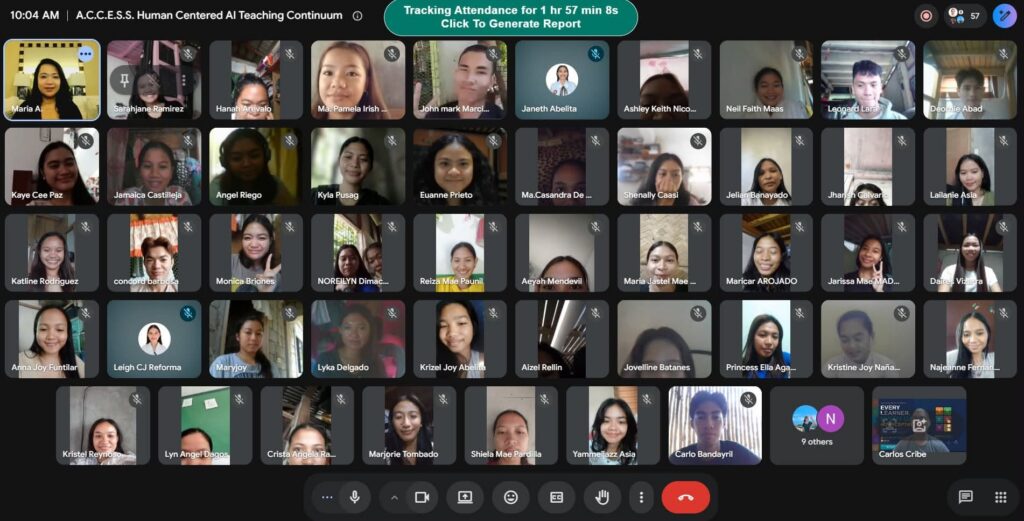
A co-teaching session at PUP Mulanay Quezon Campus—and what 56 pre-service teachers said when nobody was performing for a grade
I want to tell you about a classroom in Mulanay, Quezon Province—about four hours south of Manila—where something happened this September that I’ve been thinking about every day since.
I was a guest in Sir Carlos Cribe’s ELED 314 course at the Polytechnic University of the Philippines Mulanay Campus. The students are pre-service teachers in the Bachelor of Elementary Education program. Most of them will go on to teach in Filipino public schools—classrooms that include multilingual learners, students with disabilities, and children whose first language isn’t the language of instruction. They are, in other words, exactly the kind of teachers the world needs more of.
And they had never formally encountered the idea of human-centered AI teaching before that morning.
What I brought to them wasn’t a tutorial on which apps to download. It was the Human-Centered AI Teaching (HCAIT) Continuum—a framework I built specifically because the generic conversation about AI in education wasn’t built with vulnerable students in mind. At the end of the session, I asked them to fill out a reflection form. Fifty-six responded. And what they wrote stopped me in my tracks.
Why I Was in That Classroom in the First Place
This isn’t a story that starts with a conference invitation. It starts with Sir Carlos, who teaches ELED 314—Teaching English in the Elementary Grades—at PUP Mulanay. He’d been following the A.C.C.E.S.S. Literacy Framework work, and we’d been in conversation about what his pre-service teachers actually needed to walk into 2026 classrooms prepared.
The honest answer: they needed more than the ten traditional language-teaching methods in the textbook. Not because those methods don’t work—they do, and the course backbone is solid. But teaching a 2026 classroom full of multilingual learners without any framework for using AI responsibly is like being handed a map of a city that doesn’t exist yet.
So we revised the course together. The HCAIT Continuum became the 11th technique in 12.2—right after task-based language teaching, before the unit shifts to task design. And the course now closes, at 12.13, with the A.C.C.E.S.S. Literacy Framework replacing the GRASPS model as the culminating design tool.
The revision logic: The HCAIT Continuum was positioned after the methods survey and before task-based teaching begins—intentionally. It bridges classic pedagogical methods with the question every future teacher will face: where does AI fit, and who stays in charge of the learning?
What the HCAIT Continuum Actually Is
Before I walk you through what happened in the room, let me explain what I brought.
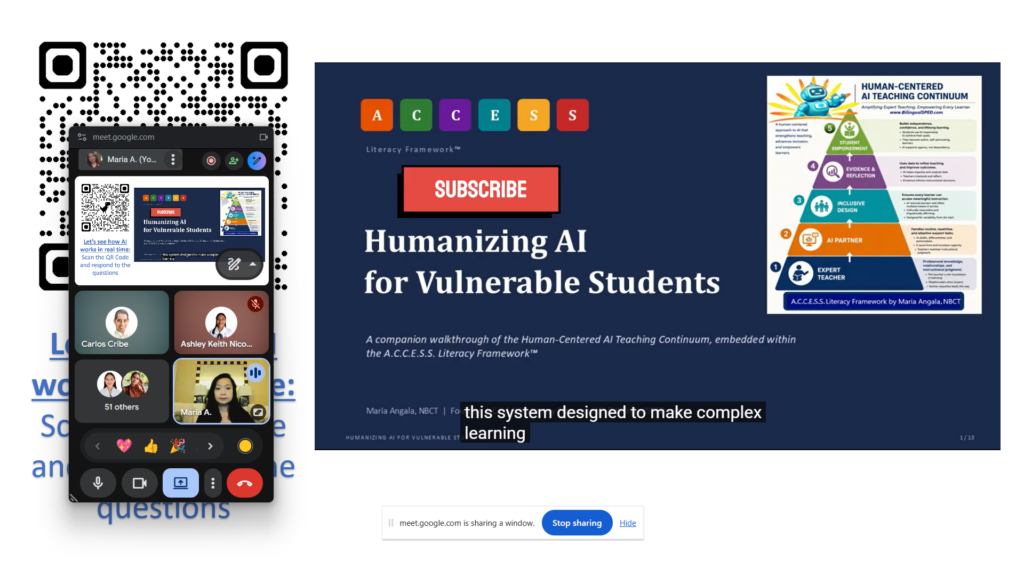
The Human-Centered AI Teaching Continuum has five levels. And the most important thing to understand about those levels is that they’re sequential on purpose—each one depends on the one below it holding.
Level 1 — Expert Teacher
The teacher is the foundation. Professional judgment, relationships, knowledge of individual students—none of that is delegated to a tool. Generic AI, I tell teachers, is autopilot: built for average conditions and average learners. A classroom with language barriers, disability profiles, and diverse home lives is off-road. You need a human driver who knows every bump in the terrain.
Level 2 — AI as Partner
AI drafts. The teacher edits everything. Full stop. Every generated material—a leveled text, a sentence frame bank, a vocabulary list—is a first draft that needs expert review before a student ever sees it. The hours saved on drafting don’t go into more admin. They go back into knowing kids.
Level 3 — Inclusive Design
Build supports in from the start, not bolted on afterward. This level introduces what I call the Clarify-or-Diagnose check: is this student struggling because they’re still acquiring English, or is there a learning disability underneath that? Those look identical on paper sometimes—and getting that distinction wrong means building the wrong support for years.
Level 4 — Evidence & Reflection
The difference between reach data (a student used the tool) and outcome data (a student actually grew) is everything. AI is great at organizing data at scale. The teacher’s job is interpreting it—disaggregated by language proficiency, by disability status, because that’s exactly where gaps hide inside a class average.
Level 5 — Student Agency
The goal. Training wheels versus a motor bolted onto a bike you never learn to pedal. I tell students directly: scaffold means AI helps you get somewhere you couldn’t reach alone. Shortcut means AI takes the trip for you. The difference is whether learning happened at all. And eventually—this is the goal—the scaffolds fade, and the student is just capable.
What Happened in the Room
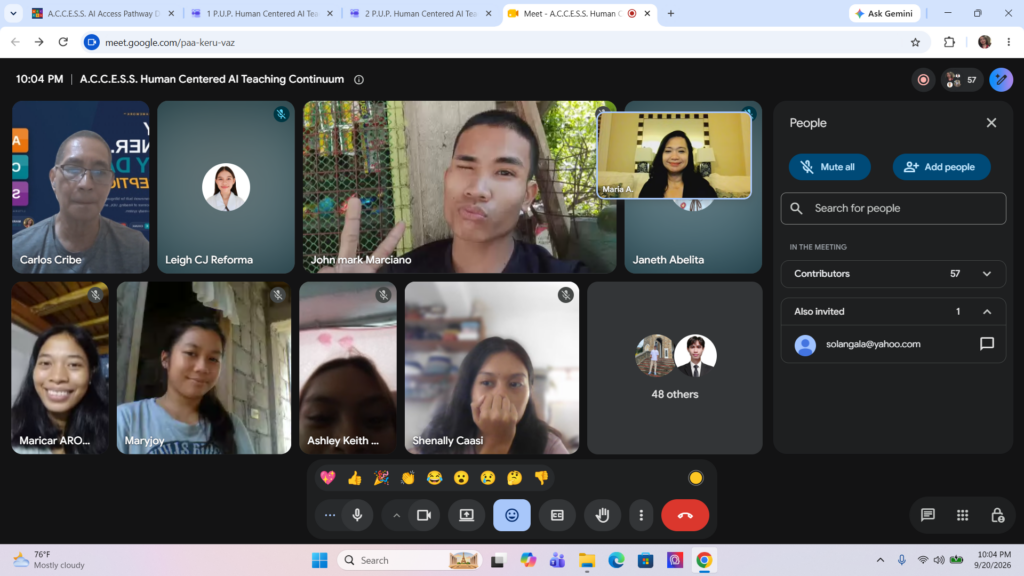
The session ran 60–90 minutes. I opened with ten minutes on why AI-integration frameworks matter specifically for multilingual and SPED classrooms—not for the average classroom the AI benchmarks were built around. Then 25 minutes walking through the five levels. Then a small-group sorting activity: real classroom scenarios, sorted into their correct Continuum level, with justification required.
The discussion that followed was the one I’ll remember. I asked: where do each of the ten methods you just studied in 12.2 sit on the Continuum today? And more importantly—how could each one move up a level?
These are junior pre-service teachers. They’d studied grammar-translation, the direct method, communicative language teaching—ten methods from the history of language pedagogy. And they were now being asked to map AI integration onto those methods and think about the trajectory. They did it. Some of the placements surprised me. The conversations were real.
At the end, I introduced three tools I built specifically for this population:
- A.C.C.E.S.S. AI Lesson Scaffold Generator — students input a learning objective and grade level; the tool scaffolds the lesson structure around it, so they’re planning with AI rather than outsourcing to it.
- A.C.C.E.S.S. AI Access Pathway Designer — takes one lesson target and generates multiple pathways to that same rigorous outcome. Differentiating without watering down.
- A.C.C.E.S.S. AI Accommodation vs. Modification Checker — students draft a support or adjustment and run it through the checker to verify: does this maintain the standard (accommodation) or change it (modification)? A distinction future teachers will need to get right for every IEP and 504 they ever write.
They were pioneer users. I told them that honestly. These tools were recently engineered and they were piloting them in real time. That framing mattered—they weren’t passive recipients of a polished product. They were participants in figuring out how something new works.
What 56+ Pre-Service Teachers Said Afterward
This is the part I keep returning to.
The reflection form asked one open question: what particular teaching strategy or skill did you learn from this presentation, and how will you use it? Anonymous, submitted digitally, not graded. This is what students say when nobody is performing.
| I learned that AI should be my thinking buddy and me as the foundation—not the other way around. — BEED student, PUP Mulanay, September 2026 |
| AI is just a thought partner, not the teacher. As a future teacher, I will use it to help me think of ideas for how to understand my students more. — BEED student, PUP Mulanay, September 2026 |
| I learned how to use AI as a scaffold instead of a shortcut. I will use AI to help me create learning materials and activities, but I will still check and edit them before giving them to my students. I will also teach my students to use AI to support their learning, not to do the work for them. — BEED student, PUP Mulanay, September 2026 |
What strikes me about these responses—and I read all 56+ of them—is the precision of the thinking. These aren’t students repeating the words I used in the presentation. They’re translating the concept into their own future classroom. I will still check and edit them before giving them to my students. That’s not parroting. That’s internalization.
One student wrote: “AI can help lessen the teacher’s workload, but it should always be used responsibly.” Another said: “We as teachers are the chief who makes commands responsibly.” And one wrote simply: “To become a teacher who uses AI as a scaffolding tool and not just a shortcut to learn.”
That last one is the whole framework in one sentence. Written by a junior pre-service teacher in Mulanay who’d never heard of the HCAIT Continuum three hours earlier.
🛒 CLASSROOM TOOLKIT | If you want the ready-made version of the tools I used in this session—the HCAIT Continuum slide deck adapted for ELED courses, the three AI tools with facilitation guides, and the scenario-sorting activity cards—I've packaged the complete HCAIT Co-Teaching Toolkit. Grab it on TpT here → teacherspayteachers.com/store/maria-angala-nbct
Why This Matters Beyond One Campus in Quezon Province
The Philippines has 700,000+ public school teachers. Most of them are teaching multilingual learners—students whose home language isn’t Filipino, or whose Filipino isn’t yet the academic register that instruction demands. Many of them will teach students with disabilities in inclusive or resource settings, often without specialized training.
If pre-service teacher education in the Philippines doesn’t include a human-centered framework for AI integration—one that explicitly centers the most vulnerable students, not the average—those 700,000 teachers will go into classrooms with powerful tools and no map for using them responsibly with the kids who need the most careful attention.
That’s not a technology problem. That’s a teacher preparation problem. And it’s solvable.
What Dr. Adelia Roadilla approved by signing off on this syllabus revision at PUP Mulanay isn’t just a course update. It’s a signal that teacher education in the Philippines can—and should—move faster than the generic AI conversation that’s been happening everywhere else. ELED 314, revised August 2026, is evidence that it’s already happening.
And from my end: this co-teaching model with Sir Carlos is replicable. The framework is designed to be brought into any teacher education program, any methods course, any professional development session that prepares teachers for classrooms with real variability. The Mulanay session was one proof point. It won’t be the last.
What Other Teacher Educators Can Take From This
If you’re teaching a methods course, running professional development, or working as a department chair thinking about curriculum revision—here’s what this session showed me works.
- Place AI as a bridge, not an add-on. Positioning the HCAIT Continuum between the methods survey and task-based teaching wasn’t random. It made AI integration feel like a natural evolution of the pedagogical history students had just studied—not a separate tech module dropped in from outside.
- Use sorting activities, not lectures. The small-group scenario sort—classify this classroom situation into the correct Continuum level, then justify your answer—generated more genuine discussion than any slide. Pre-service teachers need to practice the judgment, not just hear the definitions.
- Give them real tools to pilot. Being a pioneer user changes the psychological relationship to the content. These students weren’t observing a demo. They were testing something real and posting their outputs publicly. Ownership accelerated the learning.
- End with the equity frame. Every session on AI in teaching should close with the question: who benefits most, and who gets left out if we get this wrong? For BEED students preparing to teach diverse Filipino classrooms, that question is personal and immediate—not theoretical.
References & Further Reading
1. Ritchhart, R. & Perkins, D. — Making Thinking Visible (Harvard Project Zero)
2. Artificial Intelligence Integration in TESOL Teacher Education — TESOL Quarterly / Wiley (2025)
4. Short on Resources, Special Educators Are Using AI — The Conversation (2026)
5. Task-Based Language Teaching: Research and Practice — Nunan, D. (Cambridge University Press)
Frequently Asked Questions
Q1: What is the Human-Centered AI Teaching (HCAIT) Continuum and who is it for?
The HCAIT Continuum is a five-level framework for integrating AI into teaching in ways that keep professional judgment, student relationships, and equity at the center. It was built specifically for classrooms with high variability—multilingual learners, students with disabilities, and mixed-profile groups where generic AI tools fall short. The five levels—Expert Teacher, AI as Partner, Inclusive Design, Evidence & Reflection, and Student Agency—are sequential: each builds on the one before it, and none of them work if you skip ahead. It applies to K–12 teachers, pre-service teacher education programs, and anyone designing professional development for educators working with diverse student populations.
Q2: How can teacher education programs integrate the HCAIT Continuum without overhauling their existing curriculum?
The PUP Mulanay model shows how: you don’t need to replace the curriculum. ELED 314 kept its full methods survey and task-based language teaching sequence intact. The HCAIT Continuum was added as a bridging session between the methods survey and the task-design sequence—a single 60–90 minute co-facilitated session that positioned AI-augmented pedagogy as the logical next step after studying classic methods. The course closes with the A.C.C.E.S.S. Literacy Framework replacing the GRASPS model as the culminating design tool. Two targeted changes, one revised course. The existing backbone stays; the orientation toward future-ready teaching shifts.
Q3: What is the difference between an accommodation and a modification—and why does it matter for AI-generated supports?
An accommodation changes how a student accesses or demonstrates learning without changing the standard itself—extended time, a text-to-speech tool, a sentence frame. A modification changes the actual learning standard or expectation. The distinction is legally significant in special education (IEPs and 504 plans are built around it) and practically significant in any classroom: if you accidentally modify a standard when you meant to accommodate it, you’ve lowered the ceiling for a student who was fully capable of reaching it. AI tools generate differentiated supports quickly—but they don’t automatically distinguish between accommodations and modifications. That judgment belongs to the teacher. The A.C.C.E.S.S. AI Accommodation vs. Modification Checker helps teachers verify their own work before deploying it.
The Line That Stayed With Me
Out of 25 responses, one student wrote four words that I keep coming back to:
| AI is just a tool. — BEED student, PUP Mulanay, September 2026 |
Four words. And somehow they got it exactly right.
Not AI is dangerous. Not AI is the future. Not AI will replace teachers. Just: AI is just a tool. The same way a pencil is just a tool. The same way a whiteboard marker is just a tool. What matters is the teacher holding it—what they know, what they’ve decided, and who they’re doing it for.
That student will graduate and walk into a classroom in Quezon Province, or Manila, or somewhere in Mindanao. And they’ll be surrounded by technology that will keep getting faster and more capable. And somewhere in the back of their thinking, I hope, will be the map they saw that September morning: the teacher is the foundation. Everything else builds from there.
That’s what human-centered AI teaching actually means. Not the label—the practice.
AI with a human heart. Literacy without limits.
You Might Also Like
📖 Real-Time Differentiation Without the Extra Prep Hours
📖 Why Thinking Routines Matter More Now That AI Exists
📖 From “Cheating” to “Solving”: The New AI Mindset
📖 Why the A.C.C.E.S.S. Literacy Framework Is Built Like a Bridge—And Why That’s the Whole Point
📖 10 Executive Functioning AI Prompts for SPED Teachers, OTs and SLPs
📖 Is AI Really the “Next Frontier” or Just Another Buzzword?
📬 Get Framework Updates, Co-Teaching Resources & Field Reports This post is part of a growing body of field work—co-teaching sessions, pilot programs, and classroom data—coming out of the A.C.C.E.S.S. Framework. If you want the updates as they happen, not six months later, join thousands of SPED and ELL educators who get them delivered directly. → Sign up at: www.bilingualsped.com
Before You Go — A Reflection Question
| 💬 For You: If you had to place your own current teaching practice on the HCAIT Continuum—honestly, not aspirationally—which level would you land on right now? And what’s the one thing that would need to shift to move you up a level? Drop your answer in the comments. I want to know where educators are actually starting from in 2026—not where we wish we were. That’s the only data that helps move this work forward. |