A.C.C.E.S.S. AI Learning Barrier Detector

The tool should analyze the interaction between the learner, the task, and the environment—not diagnose the student. . . A.C.C.E.S.S. AI Learning Barrier Detector | BilingualSPED.com A.C.C.E.S.S. AI Learning Barrier Detector “Find the barrier. Preserve the rigor. Design the access.” Framework: A.C.C.E.S.S. Literacy Framework • Partner: BilingualSPED.com 👁️ High Contrast 📋 Try Sample Task 🛡️ … Read more



Why Is the SIOP Model the “North Star” for Multilingual Classrooms?

The Sheltered Instruction Observation Protocol (SIOP) is a high-leverage framework that makes complex content accessible for English Language Learners and Multilingual Learners. By integrating language and content objectives, teachers can create inclusive classrooms where every student—including those with cognitive disabilities—can thrive. I remember my first year as a teacher in the regular High School. I … Read more

AI Co-Teacher Planner

The AI Co-Teacher Planner is a powerful addition to our A.C.C.E.S.S. AI Teacher Toolkit because it addresses a real challenge in inclusive classrooms: moving co-teaching from “one teacher leads, one teacher assists” toward intentional collaboration where both educators share ownership of student learning.

This tool should not simply create lesson plans. It should help general education teachers, SPED teachers, and ESL teachers design equitable instructional roles, align accommodations, plan differentiation, and reflect on student evidence.

A.C.C.E.S.S. AI Exit Ticket Generator

Here is the “A.C.C.E.S.S. AI Exit Ticket Generator”. It adheres strictly to Universal Design for Learning (UDL) principles and WIDA Can-Do Descriptors by differentiating linguistic complexity and scaffolds while maintaining grade-level cognitive rigor.

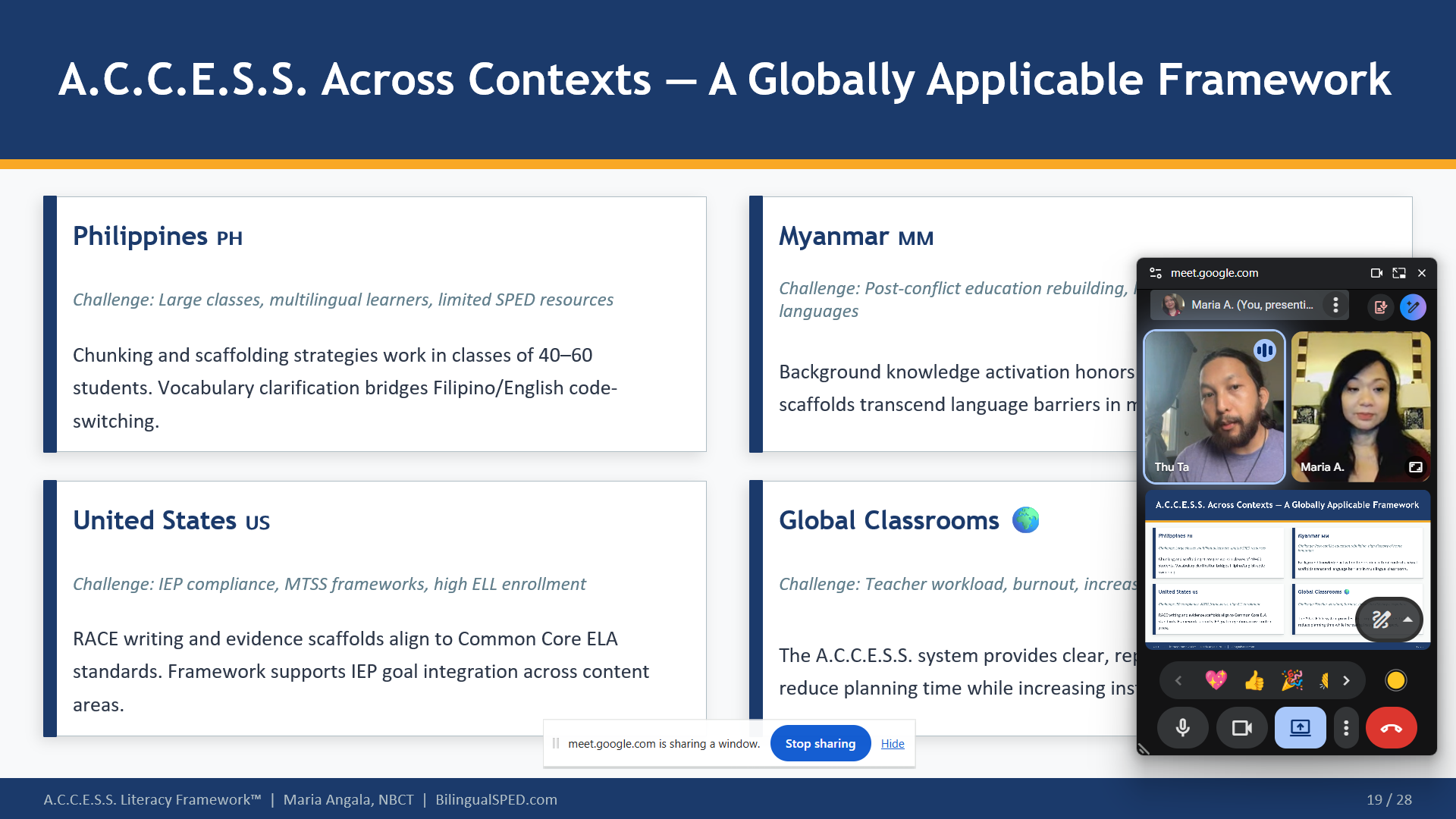
We’re Not Begging for Access. We’re Bringing A.C.C.E.S.S. to the World: Inside a Global Teacher Partnership Closing the Literacy Gap for Multilingual and Neurodivergent Learners

A national board–certified special education teacher and the founder of a Thailand-based nonprofit for displaced Myanmar educators sat down on a video call that kept cutting out — Bluetooth issues, bad audio, the whole mess. What came out of that hour says something true about how global education partnerships actually start: not in a boardroom, but between two people who finally stopped feeling alone in the work. This post walks through what we discussed, what the global data says about the literacy problem we’re both trying to solve, how the A.C.C.E.S.S. Literacy Framework™ became the bridge between us, and what a teacher anywhere can start using tomorrow.

How AI Became My Planning Support Tool— And Why I Still Make Every Final Call

When I use AI as a planning support for these students, I’m adding layers that I have to specify carefully. I’m not just saying “simplify.” I’m saying: shorter sentences, concrete vocabulary, familiar cultural references, no idiomatic language, visual cue compatibility, first-language cognate awareness if the student is Spanish-speaking.

How to Support Dually-Identified Students (ELL + Special Education): Classroom Strategies That Actually Work

I remember the first time I sat in an IEP meeting for a student who was a “dual-identified” learner—new to English and identified with a significant cognitive disability. The room was divided. The ESL teacher spoke about language acquisition stages, while the special education team focused on processing deficits. I sat there thinking, “We are looking … Read more

A.C.C.E.S.S. Literacy Framework — 55-Minute Lesson Planning Generator

. This is the lesson plan AI tool that will help you design differentiated and scaffolded lessons based on your own objectives for every student in your room. Not just the ones who already fit. . The A.C.C.E.S.S. Literacy Framework™ Lesson Plan Template is the planning tool that closes the gap between what research says works and what teachers are actually … Read more

From QR Codes to Artificial Intelligence: How Human-Centered Innovation Leads the Future of Education

AI isn’t replacing teachers — it’s asking us to get more intentional, not less human. Using the same “student first, tool second” thinking behind Dr. Ranjitsinh Disale’s QR-coded textbooks, I walk through the Human-Centered AI Teaching Continuum and show you exactly how I use AI to build sensory accommodations, multilingual visual supports, and social stories — the stuff that actually moves the needle for multilingual learners and students with disabilities.

Designing “STAR Reading Strategy” Lessons for Real Students: What My Classroom Has Taught Me About

As a Special Education and English Learner teacher at my Washington DC school, I have spent a career working with students who find the act of reading to be an exercise in endurance rather than exploration. In my Digital Literacy Academy, I am the lead teacher for students with significant cognitive disabilities, many of whom … Read more